MINES OF KHUNMAR to be published (soonish I hope)
Posted: October 1, 2010 Filed under: adventures, art, creativity, Dungeons and Dragons, Mines of Khunmar 12 Comments A few years ago I released a pdf of notes and maps (about 5 mb — 50-60 pages) of a “megadungeon” of my own creation that had been ‘under construction’ since 1980 or so. It got some approval from those who like big-ass dungeons, like here… or here… or elsewhere.
But the initial release (in 2004), although free, was just a scan of about 90% of the maps (eight levels; each level consists of around 2 to 5 maps) and very brief summaries (written by me) of what was on each level. It was just an outline.
Enter Geoffrey McKinney. He downloaded the ‘outline’ and wrote me to say that he wanted to see it printed. I hemmed and hawed and whined that the original notes were all written in pencil or ink on school notebook paper with lots of abbreviations and cross-outs and spelling errors and my handwriting was crap anyway, so he said that if I scanned the pages, he would type them up and send me an MS word copy. I took him up on his kind offer.
About a year ago, one of the OSR publishers approached me to ask if I would like to see Khunmar go to print. We had some discussions, but after a year we hadn’t made much progress, and, since I have been out of work for a while, I decided that if ever I was going to have time to work on Khunmar, it would have to be now. Previously I had released ‘Exquisite Corpses’ via Lulu and had been pleased with the way that worked out.
So I’ve decided to publish it myself. Whether via Lulu or some other means is still in doubt. I haven’t figured out what set of rules I should make it compatible with, but I’m guessing I’ll just make it as close to ‘generic D&D’ as I can using a rule set like “Labyrinth Lord” or similar.
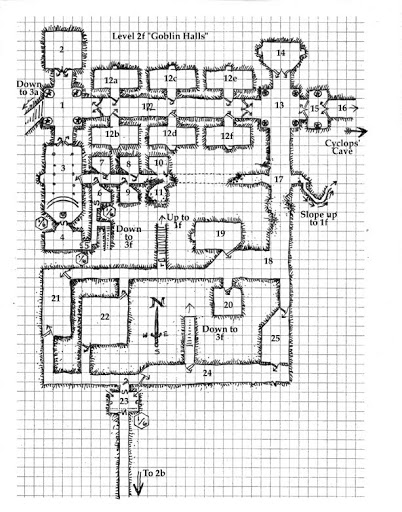
This is a massive undertaking. So far, without maps or much editing, the manuscript runs over 100 pages. The maps are all poorly drawn in pencil on yellowing graph paper and need to be redrawn. I’d like to use the book as a showcase for my illustration and will be illustrating it myself with scenes of adventurers in the dungeon itself (the picture above is my rendition of one of the encounters involving a giant cyclops and his pet hydra that I painted for my own amusement). I would also want the book to be interesting for the other dungeon masters or mega-dungeon fans to read, so many of the entries (which consist of just the name of a monster, hitpoints and treasure, if any) have to be written and ‘fleshed out.’ There are also lots of errors: missing levels, stairs that lead nowhere, mislabeled rooms, etc. An unrealistically optimistic estimate would say that the earliest it will be even close to being ready for print is a year from now.
But I’m excited and eager to see it through. As an example of how I would like to see the maps done, I’m attaching one of the maps (level 2f) below. Click to see an enlargement.
May all your hits be crits…
Posted: September 24, 2010 Filed under: arduin, critical hits, Dungeons and Dragons, rules Leave a comment Recent posts circulating the blog-o-sphere, especially those dealing with Hargrave’s original Arduin, have caught my attention. Zeitgeist seems to have struck again, and people are talking and writing about critical hits and fumbles… some of my favorite things.
Years ago, I remember encountering a very basic critical hit/fumbles table in a Judges Guild Adventure (I think it was called “Dragon Hall” or something similar). We loved it and adopted it immediately. Over the years, we added to it from Runequest and similar games that had critical hit and fumble tables. Years ago I even created one myself (see below). Up until now, this has been on a tattered sheet of notebook paper stuck into my DM’s binder; typing it up represents a big improvement.
One of the advantages of my ‘critical hit’ and ‘critical miss’ tables (if I may toot my own horn a bit) is that better (higher level combatants) are less likely to suffer bad fumbles and more likely to inflict horrendous criticals. However, I like all the possible effects of the Hargrave Arduin table (with noses being chopped off, buttocks being torn off, etc.) so I may try to figure out a way to combine the two. Perhaps when you roll a ’20’ on your critical confirmation roll (in other words, you roll two 20s in a row in an attack routine), I will add a roll from the Hargrave table to the result… which, if someone else has done their math right, means there is a 1 in 400 chance of a Hargrave critical with every attack.
Limpey’s Critical Hits/Fumbles:
Possible crits occur on a roll of 20 on the d20. Possible fumbles occur on a roll of 1 on the d20. Confirm and determine after rolling a 20 or a 1. Player characters with multiple attacks can score more than one critical in a round.*
Critical Hit: On a roll of 20 on the d20, a crit has occured. Have the player roll a d20 and modify the roll as follows:
- add +1 for every +1 of a magic weapon
- add +1 for every 3 levels of fighter (or every 3 hit dice of a monster*)
- add +1 for every 4 levels of cleric or thief
- add +1 for every 5 levels of magic user
Roll 1d20, add modifier and apply the results below:
01-05 Roll damage as normal
06-10 Roll damage 2x and add any adjustments
11-14 Maximum damage possible
15-16 Roll damage 3x and add any adjustments
17-18 Roll damage 4x and add any adjustments
19-20 Roll damage 5x and add any adjustments
*I did not allow monsters with multiple attacks to score more than one critical in a round, although I did not clue players in on this fact.
**A peek behind my DM screen: after killing a lot of PCs, I began to not add adjustments for hit dice to the roll on crits for most monsters and just used a straight-up d20 roll for monsters, but players still got the bonuses. I didn’t tell the players this because I wanted them to fear the crit!
Limpey’s Fumbles: On a roll of 01 on the d20, a crit has occurred. Have the player roll a d20 and modify the roll as follows:
- add +1 for every +1 of a magic weapon
- add +1 for every 3 levels of fighter (or every 3 hit dice of a monster)
- add +1 for every 4 levels of cleric or thief
- add +1 for every 5 levels of magic user
- subtract -3 for Dex of 3
- subtract -2 for Dex of 4
- subtract -1 for Dex of 5
- no modifier for dex of 6-15
- add +1 for Dex of 16
- add +2 for Dex of 17
- add +3 for Dex of 18
Roll 1d20, add modifier and apply the results below:
01-03 Strike self or nearest comrade(50% chance of either); roll to hit and damage as normal
04-06 Possible break weapon (save vs crushing blow) or, if attacking with hand/claw/etc., take 1d3 damage and lose next attack
07-09 slip and fall (lose round to recover; enemy gains extra attack at +2)
10-13 Drop weapon or shield or other object (1-8 feet away in random direction)
14-17 Off balance; lose next round
18+ No effect
Religon and D&D
Posted: September 16, 2010 Filed under: Dragonsfoot, Dungeons and Dragons, religion 3 Comments This from a post over at Dragonsfoot got me thinking:
[quote=”xyzchyx”]The biggest problem I would see with playing a catholic priest in AD&D is …[/quote]
[quote=”prespos”]Technically, according to [u]Modern Monsters[/u] ([b]Best of Dragon, Vol. V[/b]),
I would think that Catholic priests (or Rabbis, or Imams)…[/quote][quote=”xyzchyx”]By the book, yes… but that ruling would be incompatible with the notion of the judeo christian god, who maintains that *NO* supernatural power is good other than that which comes directly from him…[/quote]
Jeez Louise, when people start debating real life religions in D&D, it makes me want to give up on RPGs entirely.
I think it’s perfectly alright to use popular culture, movies, fables, etc., as source materials and not worry so much about what is considered truth or gospel or dogma in the real world churches (which don’t all agree, anyway — ask a religious question of a Protestant, a Catholic and a Mormon and you will get three different answers(all three would self identify as “Christians” — although I understand that some Christians say that the Mormons are NOT christians… whatever)).
In the bible, there is the story of the pharaoh’s priests tuning sticks to snakes and then Moses’ snake swallowing the pharaoh’s priests snakes — it’s not clear to me if this was supposed to indicate that the Egyptian gods had power to to turn sticks into snakes but the Hebrew God was more powerful, so the Hebrew stick-snake swallowed the Egyptian stick-snakes… or did the Hebrew God “allow” the worshipers of false gods to turn their sticks into snakes or does the story have some other meaning? And if the God of Abraham is the source of all power, both natural law and “less than natural” magic or miracles, then why would anyone be worried about occult influences from D&D books? If I could cast any spells as a result of playing D&D, wouldn’t those spells have to be ‘powered’ or ‘allowed’ by the Hebrew God?
It’s things like this that make me just want to say, “Nevermind all that” when someone gets too insistent that a game of fantasy be fueled by either historical truth or run according to someone’s real religion.
In my game, the ‘basic’ cleric can’t use swords because he is forbidden to use edged weapons. That might be based on a misunderstanding/assumption by the 19th century historians looking at the Bayeux Tapestry, but I like it so in it stays. I don’t believe in vampires… but they make great villains so in they go. I’ll base NPCs and organizations in the fantasy world on real world people and organizations like “The Spanish Inquisition” but I will also play fast and loose with the truth — and ‘Van Helsing’ types straight out of a Hammer Film or ‘Aliens’ with acid for blood are all fair game.
I don’t view D&D as a good historical recreation vehicle — it’s more fun as a pop-culture, folklore and history mash-up with an emphasis on the game itself.
What do I see? What do I know?
Posted: September 8, 2010 Filed under: Dungeons and Dragons, rules Leave a comment

If you are not familiar, a ‘knowledge’ check is a rules mechanic within an RPG where you roll the dice to see if your character knows something. If you roll well, the referee will give you a hint or a nudge in the right direction. If you roll poorly, you get no hint (or maybe even a hint in the wrong direction). If your character is smart or knows something about the subject, you might get a bonus to the roll of the dice or vice-versa.
‘Perception’ checks are similar, but instead of seeking to decide what your character does or does not know, they seek to determine what your character notices or sees. If you decide your character wants to look for the footprints of the person you want to follow, you roll a dice to see if you pick up the trail. If your character is a skilled tracker, you might get a bonus. If it has been raining and the tracks are faint, you might get a penalty.
It is worth noting that when I started playing rpgs (1978), ‘perception’ and ‘knowledge’ rolls or rules were unknown (at least to us). I quit playing for a while, and when I returned to rpgs(~2000ish), such rules or concepts were common.
In one of the first 3e games I played when I had ‘returned’ to playing RPGs, I had a character who had high STR and CON and abysmal other stats. He could fight well but I was very limited in whatever else the character could do. It was my first 3e game and I didn’t know the rules at all well, but I remember getting frustrated and bored because there was so little my character could do other than attack things. We were constantly being asked to do ‘notice’ and ‘listen’ and ‘search’ and ‘spot’ rolls… and, not to toot my own horn too much, but when the DM would describe the setting, I paid attention and try to formulate my character’s actions according to what I knew from the description I had been given — so if there were tapestries in the room, I would say that I wanted to look to see if I could spot anyone or anything hidden behind them, whereas some of the other players would just roll a dice and say, “I got a 26… what do I know?” This left me thinking that such ‘notice’ and perception rules were not a development I was interested in. Other folks I currently play with are less annoyed by the knowledge or perception rolls; they see these as means to introduce new info to the players or allow opportunities for further detailing of the environment.
Perhaps it is best to strive for a middle ground — if the player is engaged and takes initiative, and listens to what the DM says and attempts to use his or her own noodle to extrapolate info from what the DM has said or details that may have been offered up earlier, then a low “wisdom” score on the character sheet shouldn’t be as much of a handicap (perhaps the character is not naturally gifted in wisdom, but he or she is paying attention at the right time (since the player is paying attention)). One of the terms that I hear tossed around a lot that rubs me the wrong way is ‘flavor text.’ To me, ‘flavor text’ implies that the words don’t have any meaning or substance — so if the DM describes a red rug and a green metal chest, if it’s just ‘flavor text’ the colors will have no potential significance and the players can just roll ‘search’ to check for traps and whomever has the most skill points in search or perception is most likely to discover if the rug or the chest are trapped.
What I would prefer is having a situation where players can affect outcomes through thinking and remembering and describing actions and asking questions. Perhaps other items they have encountered have been color coded and the players might get a hint if they remember this… or maybe the red rug is just a rug. Players might get a bonus to their search roll if they describe what they are doing (i.e.: “I use my spear to lift up the edge of the rug and look under it — and I rolled X on my search — do we think it is trapped?” as opposed to “We search for traps and I rolled X — do we think it is trapped?” I know that creates more work for the DM, but I really like being able to interact with the environment and figure stuff out.
One of the first DMs I ever played under used the standard rules for ‘search’ for secret doors, but made us describe how we were going to open it — so even if you rolled a 1 on a d6 which meant you found the door, you might have to pull on a torch holder or press on a special brick to open it… which usually had to be determined by trial and error… which could be quite exciting/nerve racking if you were in a hurry. I thought that was a nice touch, and if I were to have my druthers, the ‘pure talking’ method of resolving such events would be my method of choice.
Welcome To Aldeboran
Posted: February 28, 2010 Filed under: adventures, campaigns, creativity, Dungeons and Dragons, fantasy, games, picaresque, project 1 Comment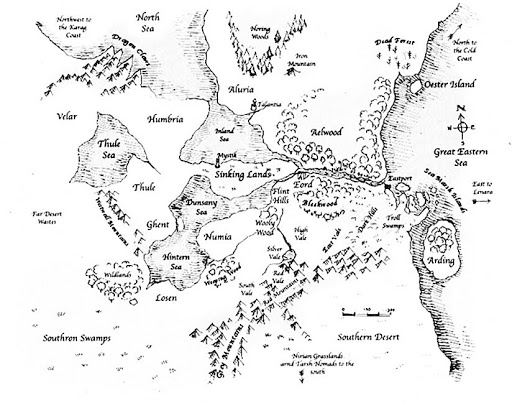 I have been calling my campaign world by several names over the past years — at one point it was ‘The Vales’ since there were different regions (Silver Vale, Red Vale, East Vale, etc.,). It has also been called ‘Hinterlands’ or ‘Northlands’ since most of the action took place is an area that was considered remote and removed from the more ‘civilized’ lands to the south and east. I also called/call it ‘Aldeboran’ (after the sun that the earth-like planet revolves around) or ‘Tellus’ (after the planet itself) but I go back and forth between wanting it to be a planet as an astronomer might define one… or just a ‘world’ which might just be a bubble in space, or moss on the back of a giant turtle… or a clump of dirt floating in space or whatever.
‘Aldeboran’ is an alternate spelling of ‘Aldebaran’ which is an actual orange giant star only 65 light years from Earth and in the constellation of Taurus. The name is arabic and apparently means ‘The Follower’ because when observed, it appears to follow The Pleiades. Lovecraft associated Aldebaran with Hastur, one of his ancient gods, so the name seemed apt.
Most of the action takes place on the large continent divided into several smaller kingdoms. Some of the places are Lenaria — an ancient empire to the east which once rules the Hinterlands where most of the action has taken place. Lenaria was 90% destroyed by meteors a few hundred years ago (or was it fire from the sky — or even some sort of stange curse or magic or weapon?) but the Lenarians still dabble in powerbrokering in the new world (they are a rip-off of the Melniboneans from Moorcock — powerful sorcerers with gigantic galleys, armies of slaves and dragon air cavalry, they worship the Dragon Goddess). The remaining islands of this once mighty empire share the names with German photographic lens formulas of the late 19th/early 20th century (Thambar, Xenar, Tessar, Summar, Summitar, Noctar, Elmar, etc.).
South of Eord lie the Vales, including Red Vale and The Red Mountains… home of the dreaded red dwarves (who are cannibals who consider everyone else as potential food). North lies a forest kingdom of Elves (named, quite unimaginatively, Alfheim), and Aluria, a kingdom of Amazons as well as other various wastelands. There is also a large swampy land known as ‘The Sinking Lands’ which is ruled by a very powerful magic user… and to the west lies Thool (or Thule) which is ruled by a priesthood who have evolved (or devolved) into creatures with enormous brains and frail bodies. Of course, they maintain armies of lesser intellects to serve and protect them. There is also the ruined city of Tana Tak, which is said to be overrun by flesh eating ghouls, but great ancient secrets are said to be buried deep beneath the ground. There are various other kingdoms, some swamplands to the south (which are littered with gigantic stone statues rumored to be the petrified remnants of gods).