Carriers (Movie:2009)
Posted: September 11, 2010 Filed under: movies, post apocalypse Leave a comment The other night I watched “Carriers,” an under promoted (and modestly budgeted) apocalypse flick that I really enjoyed.
The main characters are 4 young white 18 to 20 somethings who are travelling across the Midwestern US after a plague has decimated the population. Stars include Chris Pine (the actor who played Captain Kirk in the 2009 Star Trek flick), Piper Perabo (who looks familiar but I don’t know from what — although IMDB tells me she was in ‘Coyote Ugly’) and some others. Chris Meloni (who was on a gajillion Law & Order episodes) plays a father who briefly crosses paths with the refugees.
The premise of the film is simple: the four are a cohesive group who are determined to survive and they all practice a hygiene discipline that they hope will allow them to make it to an abandoned resort on the shore where two of the group (an older and younger brother) spent summers growing up. They don’t stop for strangers (because strangers might have the un-named disease that seems to have killed 90 percent of the population) and don’t touch anything unless they scrub it with antibacterial wipes and bleach. A few chance encounters and lies, however, sow the seeds of distrust in the group and they begin to turn on one another. This is probably less bleak than Cormac McCarthy’s The Road, but it still does not qualify as a feel good flick (i.e.: spoiler: there is no cannibalism — although you are treated to the sight of a German Shepherd chewing on the corpse of his previous owner). Issues of trust, family, euthanasia and whether or not the principle characters tell lies to protect themselves are dealt with in a fairly deft fashion.
There are ‘flashback’ scenes to the lives of the brothers shot on Super 8mm film that I felt got a little bit heavy handed, but that would be among my only criticisms of the film which I felt told a very effective story in a minimalist manner. Although Chris Pine probably qualifies as a ‘big movie star’ after his role as Captain Kirk in the 2009 Star Trek film, there are no big special effects or other spectacles that seem to be ‘de rigeur‘ in sci-fi, horror or dystopian fantasy genre films (any of which would be a fitting category for a film like “Carriers.”). It is this ‘economy of visual means’ that actually made the film more interesting. One never sees hundreds of corpses or shuffling hordes of the infected — a few blood stained pillows on empty beds and stacked body bags that look like a snapshot of post-Katrina New Orleans tell the story.
“Carriers” apparently had only a small theatrical release and then went straight to DVD, which is too bad; I’d like to see Hollywood work a little harder with less and rely more on dialogue and events than star power and spectacle to bring people back to the movies. I definitely recommend this film; although it is obviously not for the squeamish or all audiences.
Food of the Gods
Posted: August 31, 2010 Filed under: inspiration, movies 1 Comment I watched another low budget 70s sci-fi / horror movie a few nights ago — 1976 “The Food of the Gods.” It was apparently based on a part of a lesser known H.G. Wells novel and the film bears little resemblance to the source material.
If you haven’t seen it, “The Food of the Gods” is the story of a football player and his buddies who go on a hunting expedition in what I think is British Columbia or Victoria, Canada. While hunting, one of them is killed by giant wasps and when his companions find his bloated body after he had been stung to death, one of the players, Morgan, vows to discover what happened and convinces his buddy to come along.
It turns out that there is a farm nearby where some sort of mysterious substance (that looks like oatmeal) has been bubbling up out of the ground (why is never explained) and the farmer and his wife have been mixing the substance, which they consider a gift from God, with the chicken feed. This has caused their chickens to grow to the size of horses (and, I assume, lay eggs the size of beer kegs). There is an (unintentionally) hilarious scene where Morgan the football player enters the barn and is attacked by a giant rooster. This is event is communicated to the audience by having Morgan look horrified as a giant rooster puppet head and giant rooster foot are flailed at him from off camera as his anorak is shredded. He kills the rooster with a pitchfork and then confronts the farmer’s wife, shouting, “What the hell is going on around here!?! I was nearly killed by those giant chickens!”
Morgan learns of “The Food of the Gods” (or “T.F.O.T.G.”) from the farmer’s wife. She reveals that rats and insects have also eaten “T.F.O.T.G.” and grown to enormous size. A greedy businessman who wants to make millions from the mysterious substance and his winsome, spunky female biologist employee show up, as well as a man and his pregnant wife who were ‘trapped like rats’ in their Winnebago (see above). My favorite scene involves cutting between the horrified looks on the actors faces and a swarm of rats crawling all over a toy Winnebago smeared with what looks like peanut butter. An intelligent, albino rat with red eyes seems to be the ringleader.
The humans retreat to the farmhouse where large rubber rat heads are thrust into the shattering windows as the women scream and the men blast away with shotguns. There are frequent cuts to scenes of rats crawling all over a model of the farmhouse while someone apparently shoots at the rats with some sort of paintball gun filled with what looks like a mixture red paint and raspberry jam.
Later in the film, Morgan uses home made pipe bombs to blow up a nearby dam, drowning the rats. There are several scenes of what look like live rats being drowned in a fish tank. Between drowning rats by fastening their tails to the bottom of a fish tank and shooting the rats with high velocity raspberry/paint pellets, ‘The Food of The Gods’ is the perfect document for PETA to show why it sucked to be an animal in Hollywood in the 70s.
The rats all drown and the survivors pile up the rat carcasses as well as the remaining “Food of the Gods,” douse it all with gasoline and torch it. We hear a voice over of Morgan saying what a terrible thing it would be if any of that “T.F.O.T.G.” were to get into the ecosystem as we see melting snow washing some Mason jars labeled “T.F.O.T.G” into a stream, which flows into a river, where cows are shown drinking the water (and licking up the oatmeal-like “Food of the Gods” from the jars) …then the cows are milked, and, ominously, the milk is served to school children… Oh, the horror.
The Crazies (1973)
Posted: August 28, 2010 Filed under: movies, zombies Leave a comment
The other night I watched George Romero’s 1973 film, “The Crazies.” This is perhaps (un)happy circumstance, because the next day a non-fictional group of crazies descended upon the Lincoln Memorial in Washington to demand that our socialist president let (the Christian) God back into our lives while reducing taxes on the wealthiest 10%… and many of them were wearing tricorner hats adorned with tea bags and star spangled T-shirts. Or something like that.
Cheap political potshots aside, I really wanted to like this film (it has always been on my “to watch” list; I just never got around to it). I haven’t yet watched the 2010 remake with the same name in which the previews feature a demented man dragging a garden fork around in a particularly menacing manner.
I find myself enjoying Vietnam war era films a lot more these days — perhaps because they hearken back to a time when US society was dominated by a fairly bitter cultural schism and there was a fear, in the back of the minds of many, that as a society we had become too “soft” or permissive and were under attack from within (which pretty much seems to be Glenn Beck’s schtick in a nutshell; ha ha… “nutshell!”). The parallels of social unrest and the themes of a culture war in films of the 60s and 70s are interesting to me because I see some similar expressed fears in the current media stream.
Situations created by fear and mistrust that spiral out of control had been themes in Romero’s Night of The Living Dead (1968) and Dawn of the Dead (1978), so it’s not surprising to see them in “The Crazies.” But, unfortunately, for a lot of reasons, “The Crazies” just doesn’t work very well.
“The Crazies” begins with a farmer who lives outside a small farm in Pennsylvania going mad and setting fire to his farm. One cut scene later, we are then introduced to David, a volunteer fireman, and his girlfriend/fiance Judy (a nurse) as well as ‘Clank,’ David’s buddy and a fellow volunteer fireman. David and Clank set off to fight the fire as Judy rushes to the office of the local doctor to help care for the children of the dairy farmer who survived the fire.
Judy is astounded to find the doctor’s office invaded by soldiers in tyvek suits and gasmasks. It turns out that a few days earlier, a plane carrying a supply of some sort of a top secret biological weapon codenamed “Trixie” had crashed nearby and the agent/virus had made it into the water supply. We are told that the ‘Trixie’ virus kills some people and drives others insane. The doctor, worried because Judy is pregnant with David’s child, gives her a shot to help protect her and has her hide a syringe and a vial of the resistance drug in her pocket so she can inoculate David.
At some point we get to see “Colonel Peckham,” point man for the operation, putting his socks and underwear into a garment bag while talking on the phone about the ‘Trixie’ situation. He is ordered to go to the infested village and get the situation under control. Meanwhile, bombers are being scrambled into the air to nuke the Trixie town from above if needed. There are a lot of fists pounding desks and “Goddamnits” while some government bureaucrats and army men argue what to do.
There are various scenes of tyvek clad soldiers fighting crazy villagers. One soldier gets stabbed to death with knitting needles by someone’s grandmother.
Colonel Peckham arrives and sets up a perimeter guard; anyone caught trying to leave is to be detained or shot. David, Judy and Clank are captured by Tyvek clad soldiers and her supply of the resistance drug is confiscated. They manage to escape, taking Artie, a middle aged man, and Lynn, his daughter, with them and hide in a country club. Artie and Lynn, both now crazy, have incestuous sex. Clank, who is also increasingly crazy, discovers this and beats up Artie. Artie is later discovered dead, after having hung himself. Lynn, the teenager, wanders outside and is shot by soldiers. David, Judy and Clank run off after having another shootout with the soldiers.
At some point, an irascible scientist who worked on the original Trixie virus is brought to the town in hopes of being able to develop an antidote. He finally manages to do so, but, frustrated by the slow process needed to verify his identity over the phone, he decides to just hoof it over to Colonel Peckham, taking the antidote with him. He is mistaken as a “crazy” by some soldiers and forced into the local high school (where they are attempting to quarantine the crazies). Inside the high school, he is pushed down some stairs by some crazies and falls to his death. The antidote is destroyed.
David, Judy and Clank manage to ambush a few soldiers and disarm them, but Clank (full blown crazy now), kills the prisoners while David is trying to get them to tell him what they know. Judy opines that David must have a natural immunity because he is not crazy. Clank goes gonzo and starts shooting soldiers in the woods, finally getting shot himself. Judy, now showing signs of being crazy, wanders into the crossfire between some crazed civilians and soldiers and is also killed. David, his spirit broken, is captured and led away.
The movie ends with Colonel Peckham being congratulated over the phone by some stuffed shirt bureaucrat at his success in having contained the outbreak. Peckham seems depressed at how badly things have turned out. The film ends with him boarding a helicopter because there has been another outbreak in another town, and, as the new “Trixie containment” expert, he is needed to try and contain it.
Like many of Romero’s films, the ‘messages’ of whom to trust and mistrust are a bit too heavy handed for my taste, but I can’t decide if that is a factor of the awkward dialogue or lack of character development. I try not to judge the production values of films from this era too harshly (budgets were a fraction of what they are now and there was very little in the way of post-production effects available at any price in 1973), but many of the edits and portions of the sound in the film could have been much better. One of the real problems with “The Crazies” is that they try to pack too much into one story. The discussion of what the virus is and how it got into the town require a lot of exposition by the town doctor and military officers. Stylistically, I think most horror or action films have moved away from explaining what is happening as much through the characters on the screen discussing whatever problem confronts them, so perhaps I too jaded by the more modern storytelling of films like 28 Days Later, but there are places in which “The Crazies” really kind of plods along. The film switches back and forth between three stories (1st is the story of Judy, David and Clank; 2nd is the story of Colonel Peckham and 3rd is the shorter story of the doctor and his antidote) and I wonder we (as an audience) would have been better served by concentrating on just one story. I also find that characters in Romero films tend to be pretty thin as far as showing the audience their motivation. Granted, horror and sci-fi are genres where character depth and development tend to be pretty thin as a rule, but Romero always makes gestures towards developing his characters and then just leaves his principle characters as people who can be summed up in a single sentence.
I enjoyed the film and would watch it again (if I didn’t have so many things already in my queue and not enough free nights to watch them). I’d be curious to see how the remake of “The Crazies” compares to the original, but the previews of the 2010 version make it look more like a zombie/slasher film than the original.
Frontiers (Movie: 2007)
Posted: May 17, 2010 Filed under: movies, reviews Leave a comment Frontiers is a 2007 French horror movie directed by someone named Xavier Gens and starring a bunch of people we don’t know in the US because the only French actor Americans have heard of is Gerard Depardieu and he is not in this. I heard someone call it “The French Deliverance” — but its not at all like Deliverance. There are no hillbillies who rape canoeists, but there are neo-nazi cannibals. There is no river but there are some creepy mines, a pig farm, a shoot out with automatic weapons and a weird hotel. There is a lot of blood and corpses and other stuff. At one point one of the evil people turns on a table saw… and as soon as the saw blade starts to spin you just know someone is going to get ripped apart on it… and in this way the director does not disappoint. In fact, you get to see people get shot, stabbed, broiled, beaten, etc., throughout the film. If you like violent slasher films with high production values, this is the film for you (providing you speak French or can read subtitles). It is like Deliverance in one respect: at the end of the film, everyone is either emotionally destroyed or dead.
The movie st arts with some disillusioned young men (and one woman) who have taken advantage of the confusion from a riot in Paris to pull some sort of heist — what sort of heist is not explained, but they have a bag full of money. The cops are after them so they decide to get out of Paris while they can and end up at a Hotel which is obviously not listed in the Michelin guide. Here, after a strange sexual encounter the creepy occupants of the hotel and our erstwhile heroes come into extremely bloody conflict — the gore in this film goes from wince-worthy guy getting shot in the hand to ridiculous who-turned-on-the-firehose jets of blood. There were a few horrific scenes that really had me wincing (including one where a poor guy is suspended upside-down by means of hooks right through his feet — ouch! — and a really mean old nazi does something particularly horrible with a pair of pincers).
I think the movie is not particularly well known in the US, I guess because a) most people in the US who are willing to see a movie in which meat hooks and table saws figure prominently don’t want to have to read subtitles to find out what is happening, and, b) the film got an NC-17 rating which is apparently the kiss of death for theater distribution.
Not for the squeamish or faint of heart… but I’d recommend it.
Albert Fish (2007): Film by John Borowski
Posted: May 3, 2010 Filed under: crime, monsters, movies 1 Comment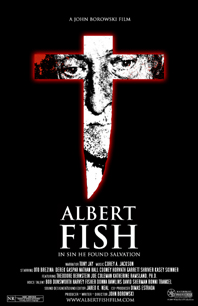 I watched “Albert Fish,” a film by John Borowski about the American cannibal and serial killer (upon whom characters like Hannibal Lecter of “Silence of the Lambs” are supposedly based).
Albert Fish (1870-1936) was a traveling house painter who claimed to have killed and/or molested children in every US state after he was caught. He was sentenced to death and executed in the electric chair for the murder of a young girl, Grace Budd, in 1928. The exact extent of his crimes are not known.
The film uses documentary film clips (many of which, based on my observation of the vehicles, are actually from the 1940s and 1950s rather than Fish’s era), photographs, interviews and re-enactments of portions of Fish’s crimes as well as dramatizations of visions that Fish claims to have (or might have had). Since Fish was into some pretty sick stuff (coprophilia, urophilia, pedophilia and masochism), these clips are thankfully less than explicit, but the production value of the film is on the low end. Other than some scenes like closeups of a whip hitting a boy’s buttocks, some fake blood and the actor who portrayed Fish drinking blood and eating a piece of what looks like raw flesh from the arm of an actor portraying Jesus Christ (a dramatization of the theme of one of Fish’s religious fascinations that may have led to his cannibalism), the visual content of the film is not overly strong, but the storys told and the letters from Fish, in which he describes his crimes are pretty gruesome.
The film features some interviews with Katherine Ramsland who speaks at some length as to what she thinks might have motivated Albert Fish to commit these crimes. Ramsland is apparently a ‘true crime’ author and a writer of books and articles on the supernatural. I found it humorous that as she was interviewed, I could see a shelf of books over her shoulder upon which, prominently displayed, was “The Complete Idiot’s Guide to Criminal Investigation.” Seeing that book did not make me find her arguements more persuasive.
Moloch: Now thats what I am talking about!
Posted: May 2, 2010 Filed under: creativity, Dero, ideas, inspiration, movies 2 Comments The above is a still image from Fritz Lang’s 1927 dystopian sci-fi film, Metropolis. Freder, hero of the film (and son of Master of the city) has a vision in which the machine that the workers tend become an idol to which the workers are sacrificed.
Moloch is (or was) a god who was worshipped by the ancient Hebrews (among others) and apparently demanded costly sacrifices. Apparently there are references in the Bible that suggest that children were sacrificed to Moloch by burning them. Moloch is sometimes described as a metal idol in the form of a man with a bull’s head which doubles as a furnace.
It’s been decades since I have sat down to watch Metropolis. Although the actors performances are pretty weird by today’s standards (there is a lot of over-the-top grimacing and pointing and gesturing and everyone wears makeup, including some pretty outrageous eyebrows as I recall), the sets and special effects really are like expressionist paintings come to life… and I remember one somewhat (unintentionally) comical scene in which an engineer who tends the machines beneath the city attempts to ward off a mob by swinging an obviously rubber wrench (it flops and bends like a massive rubber dildo). Great inspiration for settings and images, though — the picture above needs to be the setting for some sort of dero sacrificial rite…
It’s probably difficult for us to understand how radical the film might have been — in the 1920s in both the US and Germany, striking workers could count on being sent back to work by force and their strike leaders killed or arrested. Many were in virtual debt slavery while a tiny minority of the extremely wealthy lived lives of unbelievable decadence (the Weimar era parties in Berlin were famous for fountains that flowed champagne, orgies, sexual slavery, all-you-can-snort cocaine buffets and other examples of ‘off the hook’ conspicuous consumption that apparently make Dennis Kozlowski look like an amateur). All this while the working class were struggling to keep living at a level just above starvation. One of the consequences, unfortunately, is that when the socialists and police began battling in the streets for control, the fearful populace sprang right into the arms of the Fascists… but that’s a story for another time.

Green Slime
Posted: March 24, 2010 Filed under: monsters, movies Leave a commentThe good thing about Green Slime is that it has its own theme song:
And the poster is pretty snazzy too:
 I think if I run another game, green slime is going to need a serious work over.
Green Slime
Posted: March 23, 2010 Filed under: ideas, monsters, movies, music 1 CommentThe good thing about Green Slime is that it has its own theme song:
And the poster is pretty snazzy too:
 I think if I run another game, green slime is going to need a serious work over.
At the Mountains of Madness
Posted: September 26, 2009 Filed under: creativity, Cthulhu, evil, inspiration, Lovecraft, monsters, movies, picaresque Leave a comment
A movie trailer for a film that doesn’t exist (but I wish it did) mocked up by someone with access to a lot of footage from expeditions to Antarctica and a great visual sense.
Why can’t we get films like this one?