Keep on the Borderlands
Posted: September 28, 2012 Filed under: adventures, creativity, Dungeons and Dragons 6 Comments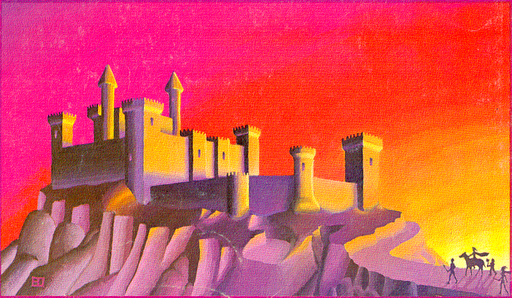 |
| If you started playing D&D in 1982 or so, you were here at some point. |
I think might be just a year or two older than the average forum lurking, blogging OD&D enthusiast because I didn’t know anything about one of the old game’s quintessential adventures, “Keep on the Borderlands” until years after it had been released. My first D&D set had a book of rules, some dice, a ‘Monster & Treasure” booklet and some maps that looked like Gary Gygax got stoned and covered a couple of sheets of graph paper in rooms and hallways that went nowhere. But for so many of my fellow enthusiasts, Keep on the Borderlands is still the true shizzle, the distillation of the D&D experience, the original article, what the game is all about, the ultimate adventure, the yardstick by which all other adventures are judged, etc. And yet I never played in it. What did I miss?
There was little rhyme or reason to those early dungeons. There would be hallways with doors sprinkled around at random and rooms filled with monsters. One room might have a group of zombies guarding a chest of silver coins, the next room might have goblins or giants spiders, etc. I don’t think any of us wondered who put the coins there or why the zombies were guarding them. We didn’t question the existence of the dungeon or why the goblins in room 2 were still alive when there was a hungry owlbear in room 3. Perhaps we were young and unsophisticated in our entertainment (the original ‘Battlestar Galatica’ was still on TV and video games were in their infancy — PONG, Centipede, PAC-MAN, etc., were considered ‘cutting edge.’). But I also think there was something else going on. We were snot-nosed punks who didn’t know shit from shinola and this game was challenging us in ways we hadn’t encountered before. We got to choose between actions and consequences. If Jim’s character was down to his last few hit points, did you announce that your character was going to jump into the fray and try to save Jim or did you slam the door and run, leaving him to his fate? We also learned of social consequences: stabbing your buddy in the back meant that his NEXT character was quite likely to stab YOUR character in turn. Maybe the consequences were not real, but the social consequences of behaving like a dick in the game taught some of the less socially gifted of our circle some good lessons in social behavior. Sometimes I wonder if this crazy game didn’t help some of us develop into actual people instead of the mouth-breathing cretins that we might have otherwise become. Or, maybe I’m just trying to justify all the time I wasted fighting orcs and ghouls while the dean of students told us we were ‘never going to amount to anything’ if we continued to play ‘that stupid game.’
So, how do we compare an adventure like ‘Keep of the Borderlands” to (for lack of a better name), “Bob’s Town and Dungeon”? (which was followed by “Stefan’s Town and Dungeon” after Bob gave up DMing duties, but I digress…) As far as a document to read, ‘Keep on the Borderlands’ is/was doubtlessly better — it features Gygaxian prose (Gygax loved his thesaurus). My home made dungeons were usually nothing more than maps with creatures and treasures tossed randomly together scrawled out in pencil; Borderlands has a fully detailed town with shops, an inn, guards, etc, with maps, illustrations, etc. The ‘Caves of Chaos’ consists of a valley filled with numerous caves (some of which interconnect) filled with different tribes (orcs, gnolls, goblins, etc.). The fans of the ‘strictly realistic’ might not find the ‘Caves of Chaos’ to their taste; it’s a bit like a “Holiday Inn” where gangs of different humanoids have checked into each suite and there are occasional rumbles down by the ice machine, but, compared to my home-made dungeons, it reads like it was written by a team of sociologists attempting to describe a dungeon eco-system with a roughly defined sort of a circle-of-life where the orcs ate goblins, goblins ate kobolds, kobolds ate rats, etc.
Playing devil’s advocate for a moment, one of the advantages of the pre-made adventure is that you can discuss it afterwards with other enthusiasts. The forums are filled with excited discussions of, “This is what happened when we played through ‘Keep on the Borderlands’ back in the day…” Maybe adventures like ‘Keep on the Borderlands’ are a part of the shared experience of the hobby. Perhaps rejecting ‘Keep’ is a form of throwing the baby out withthe bathwater. But, fuck it, part of the point of having a blog is putting whatever crazy thoughts are rolling through my head out there so anyone who cares to can read them.
Maybe I’m reaching when I compare my 13 year old self sitting down to ‘draw a dungeon’ to an artist painting a canvas… but if there is a creative component to it, I’m reluctant to disavow that by saying, “Well, Gygax is the professional, so we should stick with, ‘Keep on the Borderlands.’” Part of me feels like when people who gather to play D&D end up running nothing but pre-made adventures, they will be missing a big part of the fun (making shit up). Back in the day, one of the slogans of TSR (original publisher of Dungeons & Dragons) was, “Products of your Imagination.” If I remember right, it was printed right there on the front of “Keep on The Borderlands.” Indeed.
I think I like it ‘Dead Simple’
Posted: July 4, 2012 Filed under: campaigns, Dungeons and Dragons 1 CommentMaybe I’m just a simple minded person. Maybe I’m just lost in nostalgic meanderings which are just the first signs of senility. Maybe I just am not that clever. But I think I like what I would call ‘dead simple’ in D and D or similar campaigns/games. Not too much overarching plot. Not too many conspiracies or complicated, interwoven relationships between factions that toss the players back and forth whre they cannot keep track of one faction versus another.
“Game of Thrones” and similar might be entertaining to watch as TV drama, but I wouldn’t want to be a player in ‘A Game of Thrones’ game simply because the characters themselves are so frequently battered around by circumstances — the dwarf nobleman (I’m terrible with names; played by the actor from “The Station Agent”) is the only one in the show who seems to have even the slightest degree of choice in what he does for the first half of season 1, but even he is manipulated by events beyond his control. Byzantine dramas don’t give the individual players much agency (and, although I’m no lit scholar, that is probably how it should be in such works — we watch them to see these different characters push against each other). And I like having agency… even if its just little things, like “Which way do we go?”
A few years ago, I tried to run ‘The Shackled City‘ campaign (I think that was what it was called). This was a monster of an ‘adventure path’ from Paizo that was supposed to take the players from level 1 to level 15 or 20 or something. A few of my players were really hyped up about it; I had my doubts (especially because of the size of the book), but I wanted to be a good sport and ‘see what the new adventure path thing’ was all about. I wanted to play the new D&D the way that I thought most of the rest of the world played it. And ‘chapter 1’ was a lot of fun.
There was a ruined gnome city under the city where the players were staying… and evil ‘skulks’ were kidnapping citizens from the city to sell as slaves in the underground economy. The players made friends in the city, researched some missing kids at the local orphanage, found the entrance to the secret ruined gnome city, uncovered and eventually smashed the slaver base under the city (at great loss to themselves — only 2 made it out alive). Despite difficulty with the rules (I just can’t handle the big stat block), the players were having fun and so was I. But as I read forward in the book, I realized it got more and more and more complicated. One of the people who had been kidnapped, a teen age child, was ‘special’ in some way and was going to be a special ingredient in some world-shaking catastrophic series of events and plots. I just couldn’t keep track of it all. So I dumped Paizo’s big book. I made up a ‘new’ adventure, sometimes drawing the maps and making up the encounters I needed the night before, and I had MORE fun than I would have if I had followed the ‘Adventure Path.’ The players seemed to like it, too. I ran it for at least two years, then a player in the campaign took over DMing duties and took it off into new and unexpected directions. And I guess that’s kind of my ideal campaign.
What is ‘good RPG writing’?
Posted: June 22, 2012 Filed under: adventures, campaigns, Dungeons and Dragons, publishing 6 Comments
As a part of my day job, I have been doing some very tedious but necessary technical writing. Basically, I’m writing manuals with step by step instructions on such fascinating things as to how to fill out a purchase requisition based on a vendor quote. In order to be useful, the ‘process documents’ I am writing need to be correct in the details and their order, clear and not subject to multiple interpretations, and as short as possible since the longer the boring document or memo, the less likely it will be read. The document that results could most kindly be described as ‘utilitarian.’
At the same time, I enjoy reading fiction that is filled with possible multiple interpretations and ambiguity (current favorite: Thomas Ligotti; my all-time favorite book is hard to choose, but might be either “Heart of Darkness” by Conrad or “The Crying of Lot 49” by Pynchon), which seems funny since I have to write stuff that (hopefully) can be understood only one way by the reader for my day job yet my favorite books are ones that seem to delight in leaving the reader more confused than when they started. Providence is always giving us the finger — the guy who likes ambiguity and multiple meanings in writing has to write as precisely as he can to earn a buck.*
The Old Grind
Posted: June 20, 2012 Filed under: Dungeons and Dragons, rules 2 Comments I was reading Paul’s “Quickly, Quietly, Carefully” blog recently where he was posting about treasure and XP. Paul was looking at a published dungeon and pondering how much XP could be gathered from it in the form of XP for monsters, gold, etc., and whether or not that would be enough to raise the average party to the appropriate level for the next dungeon or adventure and it made me think a bit on of one of the staples of the old school games that seems to have fallen out of favor with many contemporary players… a little thing we call “The Grind.”
“The Grind” is where you have to earn x amount of experience points in order to advance in power so you can advance to greater challenges. The adventurer’s desire for more power turns him/her/it into a little XP whore who may start killing everything and looting everything just to earn the needed XP for ‘one more level.’ This can seem dull and mechanical, hence the term, ‘the grind.’
And ‘grinds’ seem to have fallen out of favor, at least in gaming circles I am in touch with. I used to count up every monster killed, treasure found, etc., after the session and calculate it all up, then divide it by the number of participants (with NPCs getting 1/2 share) and then letting everyone know how many XP they had at the start of the next session. I was never particularly good at (or fond of) math, but I remember enjoying this bit of book keeping, maybe because it made me feel like the rewards (XP) were not handed out by me via some system where the DM gives the players XP like some nobleman distributing favors to his courtiers. I liked to establish rules (you will get XP for X, Y and Z) and players knew the rules and would get whatever XP they earn.
One of the arguments against the grind is that it can lead to ridiculous situations in which players will notice they are just a handful of XP away from gaining a level and will then wander around looking for some weak little monster to kill so they can earn the last few XP they need to level up. Many groups of players I am familiar with simplify or handwave the process — “everyone earns X number of XP per session” or “You level up every X number of sessions,” etc. I understand why people would want to do of this: less book keeping and the rules for XP seem somewhat arbitrary (i.e.: 1 xp per gold piece FREX). I also remember the silly players in my teenage group (myself included) would do in order to earn the XP needed. I seem to remember a debate as to whether or not fireballing a herd of sheep would earn the handful of XP needed to push a character over the threshold…
However, the ‘levelling up by DM decree’ or ‘everybody gets XP just for showing up’ can also feel like the race where everyone gets a trophy no matter when they finish. One loses the feeling of accomplishment you get when your little hero earns just enough to hit the next level. When you have had to scrabble for every point, a ‘level up’ can feel like a real accomplishment.
Delayed announcement
Posted: May 12, 2012 Filed under: art, commissions, Dungeons and Dragons, fantasy 2 CommentsPaolo from The Lost Pages Blog commissioned me to do a color illo for a cover for his Adventure Fantasy Game; I shipped it off to him last week but have been distracted by other stuff; I didn’t notice until today that it was up on his site so now I can share it with you.
We see a group of intrepid explorers with pistols, swords and spells fighting their way through a horde of skeletons. Maybe they are going to that castle in the valley?

I went to Greyhawk Ruins and all I got was this lousy T-Shirt!
Posted: March 8, 2012 Filed under: campaigns, Dungeons and Dragons, underground 8 Comments I’m just riding on Grognerdia’s coat-tails here, but I’ve always liked “Greyhawk Ruins” even though the Greyhawkites probably mostly hate it… and the fact that I like it is probably an indictment of my low standards and questionable taste. I don’t really want an ‘official’ Castle Greyhawk but understand that many do. ‘Greyhawk Ruins’ probably disappoints the serious Gygax fan, but, since I don’t have a horse in that particular race, this represents no skin off of my nose. In my own case, if I were to use it (unlikely), I wouldn’t insist that players accept it as “the real deal.” Then again, I don’t want anything ‘canon’ or official anyway. I’d probably rename it something silly and derivative like ‘Blackhawk Castle’ or ‘Greymoor Castle’ and plop it right between ‘Verbosh’ and ‘Valley of the Umpa-Lumpas’ on my map.
OK — DON’T READ ON IF YOU DON’T WANT SPOILERS!
Likes for me include that it is pretty damn big and probably qualifies as a ‘megadungeon’ with factions and little stories going on, NPCs for the players to interact with and some interesting challenges that include lots of traps, rooms where players may have to fight their way across boiling tar pits, volcanoes, flooded areas, etc. Dislikes include that some of it (well, quite a bit of it) seems more than a little monotonous (room after room filled with 10 ogres, 20 troglodytes, etc., just sitting around waiting for adventurers to show up).
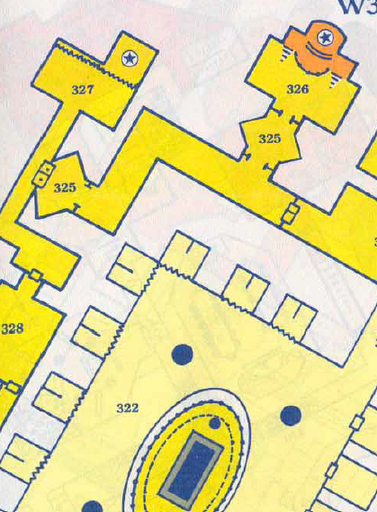 The maps are pretty weird (no grid and a color coding system that is never really adequately explained — my assumption is that the different colors are in the order of the spectrum (Roy G. Biv) with ‘red’ areas above orange, orange above yellow, yellow above green, etc.)… but, for me, the shitty maps are not a deal breaker and I can live with them. The maps are also all rendered without a scale and at an angle so the top of the page is ‘northeast’ rather than dead north, as in most other TSR D&D dungeon maps. I cropped a random section of one of the maps at right to show you what I mean.
Information is some parts is a little sketchy, but I actually prefer too little info rather than too much simply because I don’t want to read long winded essays on the history of every stick of furniture nor do I need exact counts of how many dirty socks are in the footlocker of the bedroom of the bugbear chief on the 3rd level. Just give me the bare bones and I can flesh out the details if need be. If I were ever to use this thing at the table, I would like the shorter entries since I can scan them right there at the table and, in a moment, know what the players are up against without having to stop the game so I can review several paragraphs of dense text.
 It was written for D&D 2nd edition. This makes some people unhappy but I don’t see that there is much about it that I couldn’t convert to another pre-3e form of D&D or other retroclone on the fly.
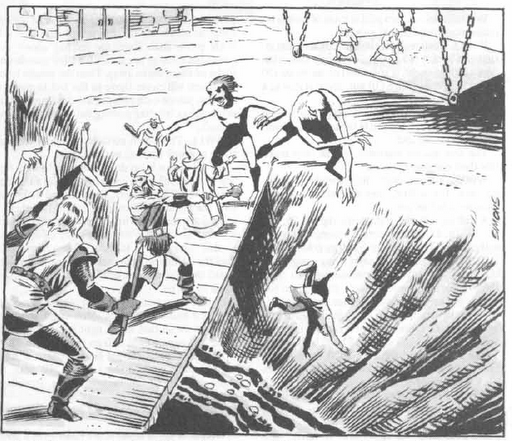
Interior art is from Thomas Baxa, Mark Nelson and Dave Simons; three artists I don’t know much about other than that they did a bit of work for TSR back in the 2e days. Most of the art looks like the art from the comic books I remember seeing as a kid from the late 1970s — sort of generic and wholesome-looking, which is a plus for me. The style of art makes me think that having Batman or Wonderwoman appear in the picture would not seem too out of place.
There is no ‘overriding’ story to the dungeon other than this: Long ago, Zagig the Wizard built a castle made of three towers where he collected his trophies, housed his guards and performed his experiments. Then he vanished and the castle began to fall apart. The dungeons beneath it are intact, however, and lots of adventurers go there. Some return with treasure; some never return at all. Of the castles/towers, little remains other than the ground floors.
The castle itself consists of three towers on mesa-like formations connected by bridges. Each ruined tower has it’s own basement, so technically I guess there are three ‘dungeons’ but they have a few inter-connections between them. The main tower is ‘Tower Zagig’ which is supposed to be the most dangerous. The left tower is ‘The Power Tower’ in which Zagig performed his many experiments. It’s front door is guarded by a group of elves. The right tower is ‘The Tower of War’ which is guarded by dwarves. If I remember correctly, the dwarves and elves demand visitors pay them a tribute for the privilege of using the doors to their respective towers.
Potentially, players can just go to the Ruins to bag XP and gold. There are also several factions (groups competing to control the dungeons, escaped slaves, a cabal of magic users who use a section of the dungeons for their experiments) that could be interacted with and the imaginative DM could figure out other quests and conflicts.
Sadly, I doubt I’ll ever get the chance to use ‘Ruins of Greyhawk.’ My days of running players through dungeoncrawls are probably long behind me; I don’t like playing online and players in my area seem to prefer a different style of game. Lack of interest from the local pool of players is probably also keeping my own Megadungeon, Mines of Khunmar, as something I will get to finishing “someday.”* And, really, who cares? What is in ‘Mines of Khunmar’ that is any better than anything else a halfway creative person with a lot of time of their hands can make?
* “someday,” with each passing real day, becomes more and more like “never.”
Are you going to be your character?
Posted: October 23, 2011 Filed under: Dungeons and Dragons, rules 6 Comments
I was reading the blogs this morning and stumbled on Noism’s Monsters & Manuals blog where he had recently posted an interesting read about ‘Life Lessons.’ One of the things that struck me was his ‘life lesson #1’:
You really, absolutely, definitely, unquestionably, indisputably, do not need a detailed character background before play begins. In fact, all you really need is a name, a class, stats, and some equipment, and you’re good to go – because within five minutes of the game beginning you will without fail find your character beginning to take on a personality of his own. This strange and almost mystical emergence of character through play is one of the best things about the hobby, and it amazes me that people have been so determined, for decades, to kill the concept.
I thought it was a good summation of some of my recent disenchantment with ‘new school’ rpgs (if I may use such a broad term).
But as I thought further on it, I began to question if the ‘character’ (or ‘avatar’ or whatever you want to call it) really needs any personality of his/her/its own. If I sit down to play D&D and I create the character ‘Stumbo the Dwarf,’ do I really need to justify what I have ‘Stumbo’ do beyond the idea that I may want to do it? Is “Stumbo will open the door because he is by nature greedy and curious and he hopes to find treasure,” to be considered better roleplaying than, “Stumbo will open the door because I want to see what is behind it“?
I’m starting to wonder if all characters can’t just be an excuse for ME to have fun exploring the fantasy construct of the imaginary world with my fellow players (without death and other consequences). Sure, as Stumbo I’ll do things I would never attempt in real life, like staring down medusa or jumping over pits filled with poisoned spikes, but start to think that creating a ‘character’ in terms of personality attributes begins to fell a bit artificial to me, or a case in which we are trying to make Dungeons & Dragons more like a cooperative novel. And I question if it is suited to that role.
Favorite Monsters Revisted: The Beholder
Posted: August 18, 2011 Filed under: Dungeons and Dragons, monsters 2 Comments
It can’t be the hardest quiz if I got 60%
Posted: July 27, 2011 Filed under: Dungeons and Dragons, games 3 CommentsHappy Birthday, Gary Gygax. I was surprised I scored as high as I did since so many others seem to know so much more Gygax-lore than I do.
 Stefan took the Hardest Gary Gygax Quiz in the World and got 60%!
You are a Gary Gygax Myrmidon. You are mighty in the ways of Gary Gygax. You’re probably a First Edition or OD&D player, and I wouldn’t be surprised if you had an original copy of the Chainmail rules.
Paladin Code: You completed this quiz without using Google.
The Success and Failure of Gygaxian Naturalism
Posted: July 13, 2011 Filed under: Dungeons and Dragons, games 5 Comments One of the fun things about D&D that was integral to the whole concept of the game from day one was the idea that ‘things’ in the D&D world more or less worked like they did in the real world but with magic and the fantastic and mytholgy just rolled in. So rats ate dead adventurers, kobolds ate the rats, goblins ate kobolds, etc., and a big gelatinous cube came through and cleaned it all up in order to prevent the dungeon passages from getting impassibly clogged with bones, torch stubs and orc dung. I think some people call this “Gygaxian Naturalism” (although I don’t know who coined the term or how it was originally intended; this is the meaning I have gathered through the context in which I have seen it used).
“Gygaxian Naturalism” is probably not good enough for science, but a vague outline of the circle of life exists in the fantasy world, allowing us to sit down and enter the fantasy world with enough ‘real world’ knowledge to help us along. It’s one of the things that helps a new player easily immerse themselves in the game. So one might know, without having been told, that in the fantasy world water is wet and our newly rolled up dwarf characted will drown if held underwater. The fact that one had to employ knowledge of the real world to navigate the fantasy one made immediate intuitive sense to me when I first sat down to play. How far my character could move in my turn was deduced by how fast I wanted him to move (did I want him to stroll or run?) and whether or not he was heavily burdened with armor, weapons, treasure, etc. It is difficult for me to convey how ‘different’ this was in my circle of friends in 1978 when we first started playing.
One of the places where ‘Gygaxian Naturalism’ breaks down for me is in the intersection between monsters of myth/legends and those same/similar monsters presented in D&D. Initially, learning that in D&D, ‘Medusa’ was not the proper name of one of the gorgon sisters killed by Perseus but rather the species name of a woman with snakes for hair and a parlyzing gaze was somewhat confusing. Discovering that “gorgons” were not the daughters of a sea god but were, instead, a bull covered in iron scales was, similarly, disconcerting. This made my meager knowledge of mythology less useful in the gaming context but delivered the advantage that in the Greek myths, Perseus could defeat Medusa only once since once she was dead she was gone, whereas in our D&D games we could kill (or, more likely, be petrified by) medusas every session. I think the trade off is well worth it.