Stonehell: First Impressions
Posted: June 24, 2011 Filed under: blogs, books, Dungeons and Dragons, Mines of Khunmar, OSR 5 Comments OK, I know it’s already been out forever but I finally got around to ordering Stonehell Dungeon by Michael Curtis after having read about his campaigns on his blogs (one blog is Torch, Pole and Rope; the other is Rotted Moon). 134 pages for $13.00 seems like a bargain to me.
I’ve only read the first couple of pages and skimmed through the rest, but so far am very happy about my purchase and feel inspired to hopefully get off my butt and do something with Khunmar once I get some of my other backlog of projects squared away.
Likes: Brief entries for room descriptions, lots of options, map on one page and key on the facing page to prevent lots of flipping of pages during play. Lots of charts for random stuff and suggestions on how to make Stonehell your own.
Dislikes: Almost no art (sad face) but I suppose that makes the compact layout possible. Not all of the info for a given location is in one place (i.e.: the description of an area on the surface near the entrance is partially in the introduction to that ‘level’ in one place and partially in the key. I guess that’s needed to keep the key compact enough to fit on one page but I’d be worried that I would forget something important if I was referencing only the key.
This is apparently just the first volume; more levels are to come!
Don’t be afraid of Nostalgia
Posted: June 20, 2011 Filed under: Dungeons and Dragons, philosophy 10 Comments I don’t think I am really a member of the ‘gamer’ subculture. I don’t really care about super heroes (but I like the way Jack Kirby draws). I get bored with video games and board games. I don’t like reading rule books. Electronic gadgets, Cthulhu references and debating the merits of the ‘Sci-Fi’ (or ‘SyFy?’) channel does not float my boat. I don’t collect anything.
All of this means I don’t really know what to do with my interest in ‘old school’ D&D. I have a bunch of old lead minis that I like, and my old books and all kinds of ‘adventure materials’ that I have made up, but no one I know seems to share my enthusiasm for such lowbrow role playing. I think my interest in D&D is, to a large extent, probably mostly nostalgic.
I don’t particularly want to play a new and improved version of D&D or some other game. The way I used to play it, with a few house rules and misunderstandings and simplifications, sounds great to me. I suspect that is probably unattainable. Maybe you can’t go back.
This quote from Ethan Gilsdorf on Salon seems a pretty good description of what I am thinking:
‘Pure and simple, for many, D&D represents a lost age: It was an individualized, user-driven, DIY, human-scaled creative space separate from the world of adults and the intrusion of corporate forces. As Allison rightly noted, D&D recalls that day “before orcs and wookiees were the intellectual property of vast transmedia corporations.” Back when you had lots more free time than money — before girlfriends, job, kids. Life.’
Palin says "Fuck U" to the Press, DCC RPG thoughts
Posted: June 10, 2011 Filed under: Dungeons and Dragons, games, Goodman, politics 8 Comments I started this post with a thing about Sarah Palin not because I have anything important or intelligent to say, but only because I am trying to maintain my cred as a left leaning liberal retard who hates the party of tea. But Alaska’s decision to release emails requested by the press under FOIA from Palin’s brief time as Govenor in the form of documents printed on paper in boxes instead of just transferring them electronically is a pretty blatant FUCK YOU to the press and FOIA. Printing out emails? Who does that? Way to go, Alaska. You have put the ‘goober’ back into ‘gubernatorial.’
Interestingly, it took Alaska longer to comply with the FOIA request than Palin spent in office.
At least there were no crotch pictures.
In other news, have only just gotten started reading the DCC RPG (I’ve spent more time reading about other people reading the DCC RPG than I have spent reading the DCC RPG, which seems as stupid as distributing emails by printing them out and packing them in boxes instead of just, you know, keeping electronic communication electronic instead of punishing all those trees because of an incovenient FOIA request). One of the things I have been reading in a few of the other views on the DCC RPG is things that people don’t like because they are different from ‘regular’ D&D. I hope those ‘differences’ make it through beta and after the test period we get a game that might be even more different than D&D.
Christians in D&D?
Posted: June 8, 2011 Filed under: Dungeons and Dragons, religion, rules 3 Comments The AD&D books recommend that in order to avoid offending anyone, “real world & modern day” religions be avoided in game play (although, bizarrely, Hindu, Native American and Shinto religious figures were included in the Deities & Demigods book— I guess to TSR, “real” meant Christian and Jewish).
I wouldn’t care if a player wanted to pretend his PC was a ‘Christian’ or not. Back in the day one of the guys I played with had a cleric he named, “Father Francis the Franciscan.” An NPC cleric in my first game was a cleric at the Church of Saint Alphonzo (named after the church in a Frank Zappa Song). Another player wrote “Yahweh” at the top of his character sheet and when I asked him why, he said because that was the god his character worshipped. Half of our cleric minis had little crosses in their hands or hanging around their little lead necks (see image of the ‘Dungeon Dwellers” clerics at above right; I think three out of four are carrying or wearing crosses and the other one has an ankh — I still have most of those little guys. They also made an “evil cleric” mini and you could tell he was evil because he had a grimace on his face and was holding his cross upside down! Just like a satanist from a horror movie!). We didn’t delve too deeply into what form their prayers or observances took (no, we did not try to really cast spells beyond saying, “My character will cast Magic Missile at the troll!” and the like).
In the first version of the rules I owned, the price list included things like “wooden cross, silver cross,” etc., until it was later replaced in the newer editions by the more P.C. term, “holy symbol.” There was holy water in the rules and a reference to killing a vampire by filling it’s mouth with holy wafers and the pictures of clerics in the books sometimes looked like Friar Tuck or was wearing a cassock, surplice or mitre or swinging incense censers or holding chalices (admittedly, I now know the mitre was also worn by Babylonian priests)… so, to this former altar boy, much of the trappings of ‘make believe’ D&D religion came from the real world Christianity and it didn’t bother me (and I considered myself an observant Catholic at that time). I just didn’t see the harm in having the references to real world religions in fantasy, and, honestly, I still don’t — I think most of that stuff was excised to be more P.C. in the wake of “D&D is devil worship!” scandals and Geraldo Rivera style “journalism.”
Hirelings and "The Mule Abides"
Posted: April 12, 2011 Filed under: Dungeons and Dragons, rules 2 Comments Eric Minton made a recent interesting post about Hirelings on “The Mule Abides” about players ditching or eliminating hirelings in order to game the XP system for more benefit to the PCs.
He said: (I previously posted on the subject of)“…how players try to ditch their hirelings in order to avoid giving them a share of treasure… it’s an emergent behavior that comes out of the intersection between rules and player goals: if the aim is to acquire gold and XP, and hirelings bleed off gold and XP, then it’s in the PCs’ interest to ensure that the hirelings perish in the line of duty before they can get their share… “
Minton then goes on to describe some of his suggestions for dealing with the topic; well worth a read if such things are of interest.
But it also sparked some thoughts in my own brain about hirelings in D&D… and reminded me of some thoughts I had in recent years on the subject.
I think when we first started playing D&D, we were playing a ‘sandbox’ game without really knowing it. We would roll up player characters, then we would have these player characters traipse off into the dungeon to kill things and get treasure. There was no ‘overarching plot or goal to it (and, in the context of this post, I’m avoiding arguing over whether or not that was a good or bad thing). We believed that one could not have XP levels that one did not earn and EVERY PC had to start out at level 1. We just thought that was how it was done.
At some point, however, in my childhood gaming group, we started rolling up PCs that would be of the appropriate level for a published adventure that we wanted to play if we did not already have one. This seemed like fun at the time… and that is still how we ‘do it’ in the game group I currently play 3.5e with.
One of the things I proposed to the group of guys I play with is a campaign where players all had to start out at level 1 but players could have more than character. Only 1 character could be your “active” PC at a time — all others would be temporary NPCs while the primary PC was under the player’s full control. Although I thought the idea had merit, the few players who expressed an opinion didn’t like the idea.
I was not running a game at the time that I made the suggestion. Any thoughts?
A to Z: B is for Bandits!
Posted: April 2, 2011 Filed under: A to Z, adventures, Dungeons and Dragons, monsters 1 Comment Today’s letter is ‘B.’ B is for ‘Bandit.’ I’m not talking about the dog who accompanied Johnny Quest… nor am I referencing the CB handle of Burt Reynold’s character in “Smokey and the Bandit,” but unlawful types who lurk in the wild places of the world and rob others.
A to Z: A is for Assumptions
Posted: April 1, 2011 Filed under: A to Z, Dungeons and Dragons, games, rules 1 Comment
 I would start with ‘default D&D’ as my first shared assumption of what players are getting into when they sit down to play a fantasy game. And if you are reading this blog, you probably know what your own conception of ‘default assumption D&D’ is. Open the rulebook and read the rules. If it says that player characters can be humans, dwarves, elves, etc., and can perform as fighters, magic users, thieves, etc., then that is a big part of the ‘assumption’ of default D&D.
E-Tools is for fools
Posted: March 30, 2011 Filed under: Dungeons and Dragons, rules 3 Comments I am a player in a D&D 3.5 game that meets once every two weeks. Recently the DM asked the players to create 15th level characters for a ‘special event’ of some kind (I have no idea). Because I am lazy, I used a character creation software to create my 15th level character. If it matters, I created a pixie ranger. In D&D 3.5e, there are rules that allow you to create a character of any monster race (even the gelatinous cube has a strength, dexterity, wisdom, etc., scores). Each monster ‘race’ is given an ‘equivalency’ to a character — so if you want to create a 15th level human fighter, the human will be a 15th level fighter… but a bugbear fighter will be 12th or 11th level in fighter because he will have 3 or more levels of ‘bugbear.’ So I have a 9th or 10th level ranger who can fly, turn invisible, etc., and shoots arrows with great accuracy (for something like 1-3 points of damage) and he is considered ‘equal’ to a 15th level human ranger because he has a buttocks-load of special abilities.
With all of the feats and skills and other shit to keep track of, I actually need a computer program to create a character if I want to create such a character according to the rules and in less than an hour’s time — a circumstance which bugs me. Then there is the fact that E-tools is (at best) unreliable, slow and crash prone. My experience with other similar products (some of my fellow players use a java based program that does the same thing; I can’t remember its name) isn’t much better. Since Wizards pulled the plug on D&D 3.5e, e-Tools is no longer supported.
One of my ‘dis-enchantments’ with 3.5 edition stems from the fact that character creation is just so complicated. Even if I just stick with the “player’s handbook,” there are lots of feats, skills and special abilities to be chosen. And many of the feats are ‘nested’ in other feats and abilities. So if you want to have the ‘great cleave’ feat, you have to pick ‘cleave’ first. In order to get ‘cleave,’ you need ‘power attack.’ In order to get ‘power attack,’ you need to fulfill some other requirements. This results in a game where players need to plan out their characters well in advance (i.e.: in order to get a feat like “Great Cleave” in the future, I need to pick the right feats and fulfill the pre-requisites beforehand). It makes planning a character like a visit to your college course advisor. And some players seem to love this ‘ongoing character generation’ aspect of the game. I am not one of them.
I will never DM a game again where players need xcel spread sheets or computer program to keep track of what they can or cannot do in a game. If that info does not fit on one page (2 pages at most), then I don’t want to run it.
Jim Roslof is gone
Posted: March 21, 2011 Filed under: art, Dungeons and Dragons 2 Comments I’m sure everyone has heard it by now. Jim Roslof, noted TSR artist(also worked forGoodman Games and others) died the other day. Roslof was an artist whose work I always enjoyed, but he wasn’t as much of an ‘iconic’ artist for me simply because Jim Roslof started working for TSR around the time that I stopped buying TSR products (which was 1982 — I think at that point Roslof had been working at TSR only a couple of years and had done things like the cover of Queen of the Demonweb Pits and a lot of illustrations inside ‘Deities and Demigods’ (both of which I had) as well as a lot of stuff for the ‘basic’ game (most of which I didn’t have since I was playing AD&D at that point)).
Everything he did that I saw, I liked. Unfortunately, I just didn’t see that much of it back in the day because I decided to try to concentrate on girls for a while instead of D&D (I soon discovered that I was a lot ‘better’ at D&D)… and by the time I came back to D&D many years later, Roslof no longer worked at TS (although neither did Gygax or anyone else whose name I probably would have recognized). I ended up getting a lot of the books that had his artwork in them by buying up second hand 1e stuff.
I did, however, have the honor of getting a few interior illustrations into Goodman Game’s DCC #28 (Into The Wilds) which was graced by a Roslof painting on the cover (see above right). So although I never met Roslof, I did at least share a publishing credit.
One of the things I really like about Roslof is that his artwork usually featured a lot of interactions between the different creatures and characters portrayed, as if each picture was telling the story of interactions (which is a nice metaphor for the way in which the game is played).
Immersion through Interaction
Posted: March 18, 2011 Filed under: Dragonsfoot, Dungeons and Dragons, rules 3 Comments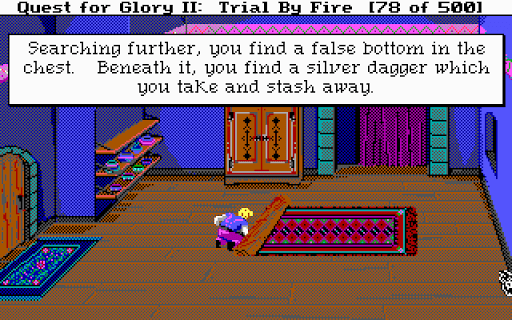 I was having a conversation elsewhere where the topic of how the referee handles “searches” in the typical D&D game. Searches, in this case, includes looking for treasure or other items, especially places in which the items sought might not be obvious to the glance or included in the referees initial description of a locale.
Back when we first played D&D, we rolled for secret doors, but not for ‘concealed doors’ (i.e.: a door behind a tapestry that you could not see unless you pulled aside the tapestry). Things that were concealed the player had to find by describing where they looked. This was (as far as we knew), the ‘correct’ way of doing it. There were no ‘search’ or ‘perception’ skills. And, if I ran a game again, I think this is how I would like to handle it.
I recall describing the characters using poles or weapons to probe things that were suspected of being trapped, etc., rather than using a dice roll. So if you thought the floor was trapped, you might toss the corpse of a dead opponent on it, etc. Personally, I find this style of play (where the player describes what or how they do things and results are adjudicated from that) to be a more immersive one than using a funny accent while speaking in the first person, predetermining psychological quirks that will artificially govern your character’s actions, etc., simply because you weren’t playing a part — you were attempting to insert yourself, mentally, into the role of the adventurer. So if you were actually physically searching the laboratory of an evil wizard for a hidden treasure, where would you start looking? I suppose one could both speak with an accent and adjudicate searches verbally, but I would posit that using accents and assuming mannerisms often falls under the general rubric of ‘roleplaying,’ as in, “I am playing the role of Fflunfreddles the Fighter who is stupid, superstitious and speaks with a broad Moronican accent…” I would offer that another interpretation of ‘roleplaying‘ might be, “I am placing myself in the role of Fflunfreddles the Fighter. I have these items and these skills. The referee has described the situation. Using what I have available in the game, what would I like to do?”
The person I was having the discussion with thought that the method I described took too much time (as opposed to using a search skill or similar mechanic). I don’t honestly think it takes up more time to adjudicate such minor tasks verbally rather than rolling for it (assuming ‘rolling for it’ involves the referee determining some sort of target number, the player (or DM) rolling a dice and adding modifiers, then comparing what is rolled to the target number, etc.).
I did notice that when I did it this way a few years ago, I did not tend to have a lot of rooms or encounter areas crowded with lots-and-lots of furnishings simply because it could get tedious to have the players describe exactly how they were searching in the 900 nooks and crannies one might find in a room crowded with furnishings… and, honestly, as DM I made up a lot of the inconsequential details on the fly. So maybe ‘realism’ in terms of room furnishings takes a hit, but so what? As DM I was not above ‘fast-forwarding’ through searches or activities that were routine (i.e.: if the player found a store room with 100 crates and announced they would search each one for valuables, I would have just determined how many hours it took, rolled for wandering monsters and given them the run-down on the contents).