Archive of the Rotted Moon
Posted: February 3, 2011 Filed under: blogs, ideas, inspiration 1 Comment Just a shout out to one of the fun blogs I’ve been enjoying lately:
Archive of the Rotted Moon is by Michael Curtis. He is also the mind behind The Society of Torch, Pole and Rope and is the author of The Dungeon Alphabet.
Atomic Knights!
Posted: November 20, 2010 Filed under: comics, ideas, inspiration 2 Comments I finally got my copy of the reprints of “Atomic Knights” comics in the mail… and I can’t wait to sit down and crack it open.
The series originally ran in DC’s “Strange Adventures” in the years 1960-1964; a little before my time. It is apparently not to be confused with another comic called “The Atomic Knight” that I know nothing about (maybe “The Atomic Knight” is about a bookworm who got superpowers by suffering a paper cut from a radiated copy of “Ivanhoe”).
The comic is set in post-nuclear holocaust America in the year 1986 (yeah, I know… but in 1960 the threat of a nuclear war on any given day was a possibility people thought about, so, in context, it works). There are all sorts of weird radiated mutants running around and a few scraps of humanity struggle to survive. “The Atomic Knights” are a collection of do-gooders seeking to keep civilization alive and help the other survivors. I guess they may have raided a museum for suits of medieval armor… and the armor apparently protects them from radiation (ah, the optimism of the 1960s). Others, like the evil Black Baron, are hoarding food and attempting to set themselves up as rulers. The “Atomic Knights” also ride around on giant dalmatians and battle foes that are animal, vegetable, mineral and extraterrestrial. What fun!
I had never heard of “The Atomic Knights” until recently, and never would have if not for the internets. Thank you, Al Gore for bringing me “The Atomic Knights!”
Two New Freaks and removeable heads
Posted: October 11, 2010 Filed under: adventures, art, ideas, Mandeville, monsters, Oz, wierd stuff 2 Comments I’ve been sick as a dog for the past week with the worst head cold of my life, so I haven’t felt particularly inspired… but somehow managed to drag my sorry ass out of bed long enough to do a few things (including attending a 5 hour event at MOCAD — by the end of which I swear I was going to pass out).
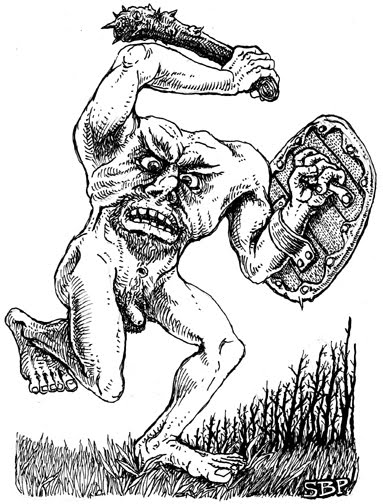
First up is another creature in a possible series from Mandeville’s travels; a cynocephale (dog-headed man). Some of the period illustrations of the cynocephales showed them as having fur all over their bodies, others illustrations show them with fur only on their heads. I opted for the fur body — he isn’t wearing anything other than a bracelet. I had a hard time deciding whether or not to give him a tail, but none of the period illustrations I looked at had tails, so I left it off.
I’ve been using felt tipped markers on a sketch pad paper rather than my regular pen, brush and ink on Bristol and am still trying to get the feel for these new tools. One of the advantages is that I can work anywhere and traveling with a couple of felt tips and a pad is easier than needing a bottle of india ink, pens, brushes, cleaning supplies, etc. I’m less happy with this one than the picture of the Blemmye I did earlier — mostly because the legs look fucked up. But I like using a paper with a less smooth surface than the Bristol, although I miss the brush a lot.
 Next up is a headless zombie, and she’s coming right down the sewer tunnel at you! This is from an adventure idea I had based on one of the characters from “The Oz” series of books. In one of the books, there was a character named Princess Langwidere who had a palace in which there were cabinets containing many ‘swappable’ heads. Langwidere could just take her head off and replace it whenever she wanted with another head from her collection. When Dorthy Gale wandered into the picture, Langwidere decided she wanted Dorthy’s head and offered her another from her collection in exchange. I don’t remember quite how it turned out (other than Dorthy retained her head), but I always liked the swappable heads idea.
The adventure idea might be a city/town location where all female visitors are carefully inspected when they arrive at the gate… and, if they have an attractive face or a nice head of hair (or are even interesting or exotic looking), they are summoned to the castle for a royal audience where the Princess/Duchess/Baroness/etc., will demand they swap heads with her because she wants their head for her collection. She wouldn’t be interested in bearded female dwarf heads or tiny hobbit heads, but human or elven heads would probably strike her fancy.
I haven’t worked out how the heads are removed — perhaps a magic axe that severs the head without all the blood and gore and death? Then the user can just put the head on the stump of the neck and it sticks like Velcro. Langwidere probably wears some sort of a choker to cover the seam. I might rule that if you ever put your own “original” head back on, it will immediately graft itself into place and the only way to get it off again (without getting killed in the process) is to use the magic axe. If, after having their head severed by this magic axe, the user does not place a head of some kind on the body, they will eventually turn into a ‘headless zombie.’
One of the possible adventures could be that the party might either have to return to the palace to either free their female companions (who might be trapped in a dungeon for having refused to give up their heads) or they might want to break into the palace to retrieve the original head of their female companion if they have been forced to relinquish their original head.
One of the ways into the castle is through the sewers… but the sewers are inhabited by the animate corpses of the Princess’ former enemies or women who made a nuisance of themselves by demanding their heads back.
Monster of the Howling Hall
Posted: August 14, 2010 Filed under: campaigns, ideas, monsters 3 Comments The Howling Hall is “haunted” by a creature that can drive anyone mad with sound and on dark nights the sounds of otherworldly music have been reported by passers by.
The “monster” of Howling Hall is actually a creation left behind by the former owner; a musician and wizard named Zann who apparently was obsessed with discovering the magical properties of sound. The “monster” is an Accordian Golem — made entirely of animate magical accordians and concertinas.
Accordion Golem (unique monster): Move 12″; AC 4; HD 6 (40 hitpoints); 2 attacks 1-6+1/1-6+1; Special abilities: 1/2 damage from blunt weapons, vulnerable to fire, regeneration, sound attack (see below).
Because the accordion golem is made up of leather and pliable wood, blunt weapons (like maces and hammers) do 1/2 damage. It can be struck by non magical weapons, but such damage regenerates at 3 hit points per round. If within the area of a silence spell, the golem cannot regenerate damage. Fire damage on the golem cannot be regenerated.
Every round, anyone within 30 feet of the creature must make a saving throw or suffer a randomly rolled effect (1d6):
- Cower in fear for 1d4 rounds. No actions possible.
- Dance uncontrollably for 1d4 rounds. Can move at 1/2 speed, AC and attacks are at -2; no spell casting possible.
- Deafened for 1d4 rounds. Is immune to the sound effect for that time, but cannot hear other players either.
- Confused: will attack random adjacent target for 1d4 rounds.
- Run away in fear at top speed for 1d4 rounds.
- Temporarily lose 1d6 points of wisdom (will regain 1 point per day of rest). If wisdom reaches 0, victim dies.
Various magical musical instruments are hidden within Zann’s Howling Halls, including a few of Zann’s “Beads of Silence.” These small fragile glass beads can be tossed up to 30 feet away, and, on impact, will create a 10′ diameter zone of absolute silence (as per the spell) that will last 2-5 rounds. There are also rumored to be various other items including a drum that can call down lightning from the heavens, a flute that can cast charm spells, a whistle that can summon a monstrous dog who will serve the whistle owner when blown and various song books and scrolls that contain the formulas for magical musical rites.
Zann had a pair of ear plugs which, if worn, made the wearer immune to aural attacks of all sorts (including the song of harpies, the sound effect of the accordion golem, etc.). However, the wearer will be 100% deaf while wearing the plugs (and spells with a verbal component are likely to fail (wisdom check on 1d20) since the caster is likely to unwitting mispronounce the formula).
The Howling Halls themselves were one of Mage Zann’s proudest achievements; he concieved the entire structure as a sort of musical instrument and aural environment. Flues are built into the walls to provide ventilation to the deepest cellars, but these flues were also designed to whistle, pipe and moan from the action of the wind, especially when certain doors are either left open or shut. It is thought that one may actually be able to ‘play’ the building like a musical instrument with different combinations of open and shut doors and that the tones produced will have different magical effects. In addition, various halls and chambers are designed to create echoes and sound effects to confuse and frighten intruders, and some of the sound effects are more than just illusions and may actually cause harm to the unwary.
Zann himself is rumored to have disappeared many years ago without explanation, although stories say that he was last known to have entered (and never returned from) an upstairs room with a curtained window which the mage would retreat to work on some of his more esoteric musical compositions for viola.
Many have tried to raid or explore the Howling Halls since Zann’s disappearance. Only one of these bold adventurers made it back. He died shortly after wandering back into town, incurably mad, raving about the ‘horrible sound of those pipes in the dark out there.’
Moloch: Now thats what I am talking about!
Posted: May 2, 2010 Filed under: creativity, Dero, ideas, inspiration, movies 2 Comments The above is a still image from Fritz Lang’s 1927 dystopian sci-fi film, Metropolis. Freder, hero of the film (and son of Master of the city) has a vision in which the machine that the workers tend become an idol to which the workers are sacrificed.
Moloch is (or was) a god who was worshipped by the ancient Hebrews (among others) and apparently demanded costly sacrifices. Apparently there are references in the Bible that suggest that children were sacrificed to Moloch by burning them. Moloch is sometimes described as a metal idol in the form of a man with a bull’s head which doubles as a furnace.
It’s been decades since I have sat down to watch Metropolis. Although the actors performances are pretty weird by today’s standards (there is a lot of over-the-top grimacing and pointing and gesturing and everyone wears makeup, including some pretty outrageous eyebrows as I recall), the sets and special effects really are like expressionist paintings come to life… and I remember one somewhat (unintentionally) comical scene in which an engineer who tends the machines beneath the city attempts to ward off a mob by swinging an obviously rubber wrench (it flops and bends like a massive rubber dildo). Great inspiration for settings and images, though — the picture above needs to be the setting for some sort of dero sacrificial rite…
It’s probably difficult for us to understand how radical the film might have been — in the 1920s in both the US and Germany, striking workers could count on being sent back to work by force and their strike leaders killed or arrested. Many were in virtual debt slavery while a tiny minority of the extremely wealthy lived lives of unbelievable decadence (the Weimar era parties in Berlin were famous for fountains that flowed champagne, orgies, sexual slavery, all-you-can-snort cocaine buffets and other examples of ‘off the hook’ conspicuous consumption that apparently make Dennis Kozlowski look like an amateur). All this while the working class were struggling to keep living at a level just above starvation. One of the consequences, unfortunately, is that when the socialists and police began battling in the streets for control, the fearful populace sprang right into the arms of the Fascists… but that’s a story for another time.

Green Slime
Posted: March 23, 2010 Filed under: ideas, monsters, movies, music 1 CommentThe good thing about Green Slime is that it has its own theme song:
And the poster is pretty snazzy too:
 I think if I run another game, green slime is going to need a serious work over.
Ye Gods!
Posted: March 22, 2010 Filed under: campaigns, fantasy, ideas, inspiration, philosophy Leave a comment
In one of Fafhrd and Mouser’s later stories by Fritz Leiber (I think it was “The Knight and Knave of Swords“), Odin and Loki end up in Newhon because their last worshipers on their home world have died (presumably that was our earth, which Leiber made mention of before as a ‘different’ world than Newhon; although if it was another dimension or just another planet is not made clear if I recall correctly). Weakened by a lack of worshipers, Loki and Odin somehow wander to Newhon where they arrive, barely alive, and are adopted by Fafhrd, the Mouser and their friends. They build up the power of these gods and nurse them back to health because they hope these gods can help save Newhon in an upcoming battle, but after the battle Loki and Odin try to betray them for more power. Happily, the evil Norse gods are frustrated in the attempt (although Fafhrd makes a painful and unintended sacrifice of his left hand to Odin).
A similar conceit (where gods gain power from their followers) is introduced in L. Sprague DeCamp‘s Reluctant King books. Jorian, the main character, finds a small statue that he keeps… and every night the god represented by the statue appears in his dream since he is now that god’s only contact with the human world (all of the rest of his followers having died). What makes it funny is that the god is constantly whining about how long it has been since someone brought him flowers and seems more of a pain than he is worth. Finally when someone steals the statue and the god disappears, Jorian pretty much considers it good riddance.
Everyone keeps telling me I have to read ‘Small Gods.’ It’s on my list.
The idea that fantasy gods draw their power from their worshipers is one that appeals to me, and I enjoy the idea of a dynamic roster of gods whose power rises and falls with the fortunes of their churches in the material planes.