Travels of Sir John Mandeville and finishing things
Posted: October 2, 2010 Filed under: art, history, Mandeville, wierd stuff 3 Comments One of my new intentions is to try and finish things. For example, I have hundreds of drawings lying around that I have been too lazy to finish. One of the ‘first fruits’ of my newfound ambition is the drawing of a creature known to our ancestors as a ‘Blemmye,’ at right.
“Blemmyes” belong to that class of creature which today would be called an ‘urban legend’ or ‘folk lore’ — like leprechauns or the Loch Ness monster. But in the 16th century, before satellites were constantly photographing the earth from overhead and everything had been google-earthed, there were still lots of blank spaces on the map marked with question marks. Someone (author unknown) wrote about“The Travels of Sir John Mandeville.” Mandeville had apparently travelled to some of those blank spaces on the map and returned to tell of the tale.
Mandeville gives details of the lives of different species of humans like the ‘Skiapods,’ ‘Cynocephales,’ the ‘Cyclopes’ and the ‘Blemmeyes.’ As you can see, the Blemmyes have no head (making decapitation and buying shirts difficult) and their faces are on their chests. Belatedly, I realized that my Blemmeye has no ears; in some of the classic illustrations, the Blemmye is portrayed as having ears that flank his eyes… and female Blemmyes are portrayed as having boobs that start on their cheeks.
 Another favorite is the ‘Cynocephales;’ a race of men with the heads of dogs (sometimes portrayed with fur). Their speech apparently sounds like barking and Mandeville notes that although they are very intelligent and reasonable, they worship a god who takes the form of an ox (I suppose thinking that god could be an ox seems just silly to Mandeville, since, as a Christian, he knows that god is really a dead man nailed to some wood).
‘Skiapods’ have one leg and a single giant foot which the Skiapod uses to shield himself from the sun. The classic illustrations of the Skiapods I have seen almost always portray them as lying on their back in the shade of their own giant foot (like in the period woodcut at right); I wonder if the skiapod puts sunscreen on the sole of his foot? Or does he just wear a big-ass shoe?
A sample of the unknown author’s prose:
From this land men go to another isle that is clept Silha. And it is well a 800 miles about. In that land is full much waste, for it is full of serpents, of dragons and of cockodrills, that no man dare dwell there. These cockodrills be serpents, yellow and rayed above, and have four feet and short thighs, and great nails as claws or talons. And there be some that have five fathoms in length, and some of six and of eight and of ten. And when they go by places that be gravelly, it seemeth as though men had drawn a great tree through the gravelly place. And there be also many wild beasts, and namely of elephants.
The book is filled with all sorts of creatures, countries, personalities and observations; like giant snails, dragons, Prester John and other weird stuff. I’ve only read bits of “The Travels of Sir John Mandeville;” maybe I’ll have to make time to read some more of it.
(edit: corrected spelling of ‘Blemeye’ to ‘Blemmye’; and discovered this was also the name used by the Romans for a tribe of Nubian nomads with conventional anatomy (it is not known what they called themselves) — how the name came to be applied to the headless people of Mandeville’s travel is unknown… also found out that ‘cockodrill’ probably means ‘crocodile.’)
MINES OF KHUNMAR to be published (soonish I hope)
Posted: October 1, 2010 Filed under: Mines of Khunmar Leave a comment A few years ago I released a pdf of notes and maps (about 5 mb — 50-60 pages) of a “megadungeon” of my own creation that had been ‘under construction’ since 1980 or so. It got some approval from those who like big-ass dungeons, like here… or here… or elsewhere.
But the initial release (in 2004), although free, was just a scan of about 90% of the maps (eight levels; each level consists of around 2 to 5 maps) and very brief summaries (written by me) of what was on each level. It was just an outline.
Enter Geoffrey McKinney. He downloaded the ‘outline’ and wrote me to say that he wanted to see it printed. I hemmed and hawed and whined that the original notes were all written in pencil or ink on school notebook paper with lots of abbreviations and cross-outs and spelling errors and my handwriting was crap anyway, so he said that if I scanned the pages, he would type them up and send me an MS word copy. I took him up on his kind offer.
About a year ago, one of the OSR publishers approached me to ask if I would like to see Khunmar go to print. We had some discussions, but after a year we hadn’t made much progress, and, since I have been out of work for a while, I decided that if ever I was going to have time to work on Khunmar, it would have to be now. Previously I had released ‘Exquisite Corpses’ via Lulu and had been pleased with the way that worked out.
So I’ve decided to publish it myself. Whether via Lulu or some other means is still in doubt. I haven’t figured out what set of rules I should make it compatible with, but I’m guessing I’ll just make it as close to ‘generic D&D’ as I can using a rule set like “Labyrinth Lord” or similar.
This is a massive undertaking. So far, without maps or much editing, the manuscript runs over 100 pages. The maps are all poorly drawn in pencil on yellowing graph paper and need to be redrawn. I’d like to use the book as a showcase for my illustration and will be illustrating it myself with scenes of adventurers in the dungeon itself (the picture above is my rendition of one of the encounters involving a giant cyclops and his pet hydra that I painted for my own amusement). I would also want the book to be interesting for the other dungeon masters or mega-dungeon fans to read, so many of the entries (which consist of just the name of a monster, hitpoints and treasure, if any) have to be written and ‘fleshed out.’ There are also lots of errors: missing levels, stairs that lead nowhere, mislabeled rooms, etc. An unrealistically optimistic estimate would say that the earliest it will be even close to being ready for print is a year from now.
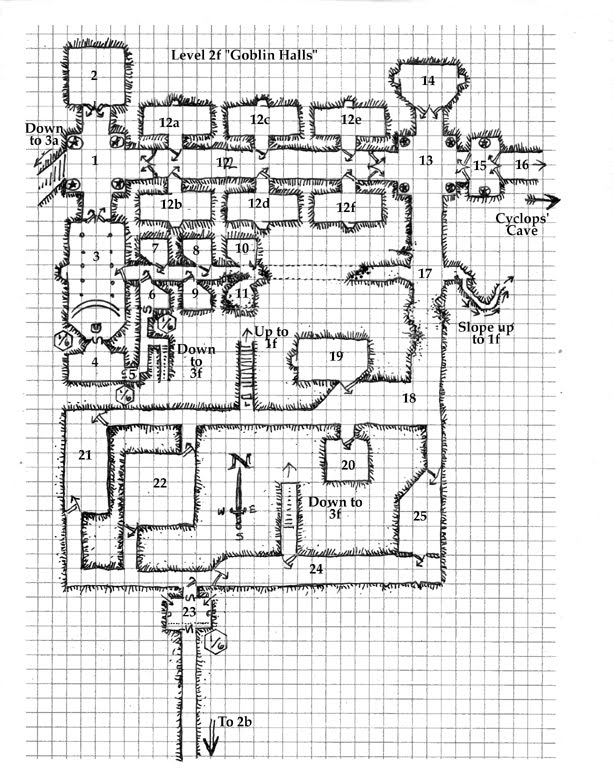
But I’m excited and eager to see it through. As an example of how I would like to see the maps done, I’m attaching one of the maps (level 2f) below. Click to see an enlargement.
I dare you to post this to your blog…; NSFW
Posted: October 1, 2010 Filed under: art, douchebaggery, monsters, weird 4 Comments
The other day I read this on Raggi’s LotFP blog:
So I’m contacting some artists and actually using the words, “Give me something that will get me arrested for publishing it.”
I am not one of the artists that Raggi contacted, but his challenge touched something in my base nature… and I wanted to see if I could draw something that would get Jim Raggi arrested for publishing it. Several ideas were considered and discarded. Zak S. (of Pornstars fame) submitted a link to a particularly good drawing that involved dildo-wielding midgets with T-pins in their eyes. I decided to consider the gauntlet thrown down and tried to combine things that would make Larry Flynt uncomfortable (for the record, I don’t think I managed to produce something that would make Larry Flynt squirm).
Cannibalism is pretty bad, so I had to put that in… but necrophilia is worse… so why not both? For some reason naked females don’t make most viewers uncomfortable, but seeing men with their dicks hanging out does… so I had to have several dicks in the drawing. But not just men who were naked with flaccid dicks — they had to be naked men sticking their dicks in places where most decent people would think they didn’t belong. Hence a goblin throat-fucking a decapitated human corpse. In retrospect, I should have included pedophilia, but one can’t think of everything. One of the goblins is eating a still living human baby while shitting in the mouth of a severed human head… that ought to count for something.
I finished the drawing and emailed a scan to Raggi, hoping to hear him say, “This will be the cover of my next adventure!” Unfortunately, all I got was:
I dare you to put that on your blog.
Maybe that’ll start one of these meme things I keep hearing about.
That Raggi is all talk.
Unfortunately, even the most casual perusal of art history reveals that all of this stuff has been done before (and usually done better — Goya’s “Saturn devours his Sons“* is so sick and cool). I’ve seen a shitload of medieval woodcuts illustrating “Der Kinderfresser” (The child eater). They even erected a statue of him in Switzerland. Torture and impaling has been well covered, especially in the illustrations of the Catholic Church going to work on the heretics and the Protestant denominations going to work on the witches. Images of rape are as old as pornography. About the only new idea I have is a goblin fucking the throat of a decapitated corpse… but surely I cannot be the first person to think of that?

*Goya apparently put this picture on the wall of his dining room where he and his family ate their meals… which must had lead to some interesting dinner conversations.
Update 12/29/2011: This picture apparently has a cult following now and is being cited as proof’ of my degeneracy and/or genius. I guess that means that as an artist I have finally “arrived.”

MINES OF KHUNMAR to be published (soonish I hope)
Posted: October 1, 2010 Filed under: adventures, art, creativity, Dungeons and Dragons, Mines of Khunmar 12 Comments A few years ago I released a pdf of notes and maps (about 5 mb — 50-60 pages) of a “megadungeon” of my own creation that had been ‘under construction’ since 1980 or so. It got some approval from those who like big-ass dungeons, like here… or here… or elsewhere.
But the initial release (in 2004), although free, was just a scan of about 90% of the maps (eight levels; each level consists of around 2 to 5 maps) and very brief summaries (written by me) of what was on each level. It was just an outline.
Enter Geoffrey McKinney. He downloaded the ‘outline’ and wrote me to say that he wanted to see it printed. I hemmed and hawed and whined that the original notes were all written in pencil or ink on school notebook paper with lots of abbreviations and cross-outs and spelling errors and my handwriting was crap anyway, so he said that if I scanned the pages, he would type them up and send me an MS word copy. I took him up on his kind offer.
About a year ago, one of the OSR publishers approached me to ask if I would like to see Khunmar go to print. We had some discussions, but after a year we hadn’t made much progress, and, since I have been out of work for a while, I decided that if ever I was going to have time to work on Khunmar, it would have to be now. Previously I had released ‘Exquisite Corpses’ via Lulu and had been pleased with the way that worked out.
So I’ve decided to publish it myself. Whether via Lulu or some other means is still in doubt. I haven’t figured out what set of rules I should make it compatible with, but I’m guessing I’ll just make it as close to ‘generic D&D’ as I can using a rule set like “Labyrinth Lord” or similar.
This is a massive undertaking. So far, without maps or much editing, the manuscript runs over 100 pages. The maps are all poorly drawn in pencil on yellowing graph paper and need to be redrawn. I’d like to use the book as a showcase for my illustration and will be illustrating it myself with scenes of adventurers in the dungeon itself (the picture above is my rendition of one of the encounters involving a giant cyclops and his pet hydra that I painted for my own amusement). I would also want the book to be interesting for the other dungeon masters or mega-dungeon fans to read, so many of the entries (which consist of just the name of a monster, hitpoints and treasure, if any) have to be written and ‘fleshed out.’ There are also lots of errors: missing levels, stairs that lead nowhere, mislabeled rooms, etc. An unrealistically optimistic estimate would say that the earliest it will be even close to being ready for print is a year from now.
But I’m excited and eager to see it through. As an example of how I would like to see the maps done, I’m attaching one of the maps (level 2f) below. Click to see an enlargement.
May all your hits be crits…
Posted: September 24, 2010 Filed under: arduin, critical hits, Dungeons and Dragons, rules Leave a comment Recent posts circulating the blog-o-sphere, especially those dealing with Hargrave’s original Arduin, have caught my attention. Zeitgeist seems to have struck again, and people are talking and writing about critical hits and fumbles… some of my favorite things.
Years ago, I remember encountering a very basic critical hit/fumbles table in a Judges Guild Adventure (I think it was called “Dragon Hall” or something similar). We loved it and adopted it immediately. Over the years, we added to it from Runequest and similar games that had critical hit and fumble tables. Years ago I even created one myself (see below). Up until now, this has been on a tattered sheet of notebook paper stuck into my DM’s binder; typing it up represents a big improvement.
One of the advantages of my ‘critical hit’ and ‘critical miss’ tables (if I may toot my own horn a bit) is that better (higher level combatants) are less likely to suffer bad fumbles and more likely to inflict horrendous criticals. However, I like all the possible effects of the Hargrave Arduin table (with noses being chopped off, buttocks being torn off, etc.) so I may try to figure out a way to combine the two. Perhaps when you roll a ’20’ on your critical confirmation roll (in other words, you roll two 20s in a row in an attack routine), I will add a roll from the Hargrave table to the result… which, if someone else has done their math right, means there is a 1 in 400 chance of a Hargrave critical with every attack.
Limpey’s Critical Hits/Fumbles:
Possible crits occur on a roll of 20 on the d20. Possible fumbles occur on a roll of 1 on the d20. Confirm and determine after rolling a 20 or a 1. Player characters with multiple attacks can score more than one critical in a round.*
Critical Hit: On a roll of 20 on the d20, a crit has occured. Have the player roll a d20 and modify the roll as follows:
- add +1 for every +1 of a magic weapon
- add +1 for every 3 levels of fighter (or every 3 hit dice of a monster*)
- add +1 for every 4 levels of cleric or thief
- add +1 for every 5 levels of magic user
Roll 1d20, add modifier and apply the results below:
01-05 Roll damage as normal
06-10 Roll damage 2x and add any adjustments
11-14 Maximum damage possible
15-16 Roll damage 3x and add any adjustments
17-18 Roll damage 4x and add any adjustments
19-20 Roll damage 5x and add any adjustments
*I did not allow monsters with multiple attacks to score more than one critical in a round, although I did not clue players in on this fact.
**A peek behind my DM screen: after killing a lot of PCs, I began to not add adjustments for hit dice to the roll on crits for most monsters and just used a straight-up d20 roll for monsters, but players still got the bonuses. I didn’t tell the players this because I wanted them to fear the crit!
Limpey’s Fumbles: On a roll of 01 on the d20, a crit has occurred. Have the player roll a d20 and modify the roll as follows:
- add +1 for every +1 of a magic weapon
- add +1 for every 3 levels of fighter (or every 3 hit dice of a monster)
- add +1 for every 4 levels of cleric or thief
- add +1 for every 5 levels of magic user
- subtract -3 for Dex of 3
- subtract -2 for Dex of 4
- subtract -1 for Dex of 5
- no modifier for dex of 6-15
- add +1 for Dex of 16
- add +2 for Dex of 17
- add +3 for Dex of 18
Roll 1d20, add modifier and apply the results below:
01-03 Strike self or nearest comrade(50% chance of either); roll to hit and damage as normal
04-06 Possible break weapon (save vs crushing blow) or, if attacking with hand/claw/etc., take 1d3 damage and lose next attack
07-09 slip and fall (lose round to recover; enemy gains extra attack at +2)
10-13 Drop weapon or shield or other object (1-8 feet away in random direction)
14-17 Off balance; lose next round
18+ No effect
Religon and D&D
Posted: September 16, 2010 Filed under: Dragonsfoot, Dungeons and Dragons, religion 3 Comments This from a post over at Dragonsfoot got me thinking:
[quote=”xyzchyx”]The biggest problem I would see with playing a catholic priest in AD&D is …[/quote]
[quote=”prespos”]Technically, according to [u]Modern Monsters[/u] ([b]Best of Dragon, Vol. V[/b]),
I would think that Catholic priests (or Rabbis, or Imams)…[/quote][quote=”xyzchyx”]By the book, yes… but that ruling would be incompatible with the notion of the judeo christian god, who maintains that *NO* supernatural power is good other than that which comes directly from him…[/quote]
Jeez Louise, when people start debating real life religions in D&D, it makes me want to give up on RPGs entirely.
I think it’s perfectly alright to use popular culture, movies, fables, etc., as source materials and not worry so much about what is considered truth or gospel or dogma in the real world churches (which don’t all agree, anyway — ask a religious question of a Protestant, a Catholic and a Mormon and you will get three different answers(all three would self identify as “Christians” — although I understand that some Christians say that the Mormons are NOT christians… whatever)).
In the bible, there is the story of the pharaoh’s priests tuning sticks to snakes and then Moses’ snake swallowing the pharaoh’s priests snakes — it’s not clear to me if this was supposed to indicate that the Egyptian gods had power to to turn sticks into snakes but the Hebrew God was more powerful, so the Hebrew stick-snake swallowed the Egyptian stick-snakes… or did the Hebrew God “allow” the worshipers of false gods to turn their sticks into snakes or does the story have some other meaning? And if the God of Abraham is the source of all power, both natural law and “less than natural” magic or miracles, then why would anyone be worried about occult influences from D&D books? If I could cast any spells as a result of playing D&D, wouldn’t those spells have to be ‘powered’ or ‘allowed’ by the Hebrew God?
It’s things like this that make me just want to say, “Nevermind all that” when someone gets too insistent that a game of fantasy be fueled by either historical truth or run according to someone’s real religion.
In my game, the ‘basic’ cleric can’t use swords because he is forbidden to use edged weapons. That might be based on a misunderstanding/assumption by the 19th century historians looking at the Bayeux Tapestry, but I like it so in it stays. I don’t believe in vampires… but they make great villains so in they go. I’ll base NPCs and organizations in the fantasy world on real world people and organizations like “The Spanish Inquisition” but I will also play fast and loose with the truth — and ‘Van Helsing’ types straight out of a Hammer Film or ‘Aliens’ with acid for blood are all fair game.
I don’t view D&D as a good historical recreation vehicle — it’s more fun as a pop-culture, folklore and history mash-up with an emphasis on the game itself.
How I Paint
Posted: September 15, 2010 Filed under: art 3 CommentsSomeone recently asked me to post a description of my methods/technique in painting. I don’t feel like I have any big secrets; I definitely need more practice.
I took an oil painting class years ago, but my partner hates the smell and is paranoid about the health effects, so, out of regard for her, I use acrylics — although I have a hard time with acrylic sometimes. But it dries much faster so I can get a painting done in days rather than weeks.
I usually thin with water; liquitex makes a painting medium that I add a few drops to a small jar of water that makes the acrylic paint flow a little easier.
I made the mistake of buying some cheap “Dick Blick” brand Acrylics years ago, but since I am cash poor, I can’t afford to replace them until I use them up. I much prefer the Liquitex brand (although it is much more expensive).
I’m trying to become more disciplined in my painting by trying to paint gradually and trying to plan so I paint from background to foreground (if that makes sense). I used to just start painting and then would try to fill in background around whatever I had painted and it created a lot of work for me and I think the overall effect suffered. So I am trying to be a bit more methodical. If I want to paint a tree against a light sky, I have discovered it is a LOT easier to paint the sky first and then paint the tree in over it. Seems obvious now but I really didn’t think about it before.
I don’t think acrylics blend very well (at least I have not yet worked out HOW to blend them well — looking at the work of others tells me I have more to learn in this regard) so transitions, from light blue to dark blue, are tricky. I paint on watercolor or Bristol paper which I have coated with a couple layers of Fredrix white painting ground. I have to tape the paper to a sheet of masonite or smooth plywood so it does not curl up. If I’m painting something for reproduction, I usually paint at what I call 65% — so if a picture is intended to be printed 10 inches wide, I paint it 16.6 inches wide. Graphic stores used to sell a ‘proportion wheel’ that I use to figure this out — it has two wheels with measurements marked on them, one indicated ‘repro’ size and the other indicating ‘finish’ size and a window that tells you what your percentage will be.
I usually apply 2-3 coats of the Fredrix ground and let it dry between coats, then sand off any rough spots or chunks. Then I sketch in what I want to paint with a light pencil (like a 2h). I usually start by painting things in their base color — sometimes I do a layer underneath of dark areas/shadows in a burnt sienna or similar earth tone, then laying ‘local color’ over it. I have to constantly remind myself not to get too caught up in details but try to just ‘rough in’ the whole painting. Periodically I try to remember to stop and look at the whole thing to make sure it is ‘working’ visually. That is another area in which I need to become more disciplined.
I try to remember to decide where my light sources in the painting will be, early on, and add highlights and shadows to match.
I generally start with a bigger brush, and, as I get further along I switch to a smaller one. I use a ‘flat’ brush for targe areas of color and smaller sables for details.
The majority of the time seems to be spent fixing stuff. I’ll paint in something and then look at it again later and realize it looks wrong, so I’ll try to fix it, etc., and then just keep repeating until I like how it looks. I’m working on getting a little more experimental with paint application — I used an old toothbrush to create a spatter pattern on one of my paintings a while ago and I really like it, so I think I should work on that some more. I also need to work on my color sense — many of my paintings look too ‘primary’ colored when I look at them later — or seem to be too light and without significant areas of contrast; I’ve been looking at some old pulp magazine covers and really digging those; I’d like to insert some more of that ‘noir’ look in my paintings.
I’d like to get better at blending, color work and fine details. I find that acrylic turns kind of thick and crumbly pretty quickly, so sometimes I struggle a bit, but I think I need to make more disciplined attempts at paint control and mixing — including experiments with thin layers of colors over other colors (which was easier for me in oil paints).
Scanning the painting is a pain in the butt. I have to remove the paper from the board and scan it in sections, then use an image editing program to stitch the sections together. The bigger the painting, the harder it is. Therefore I find it easier to just shoot a picture with a digital camera if I need a ‘work in progress shot.’ Someday I dream of buying a more expensive Canon or similar digital SLR with ~12 megapixel resolution that can use a quality lens (but, with current finances, that is unlikely). Right now I have an Olympus camera with 2 megapixels that works OK for snapshots of works in progress, but I’d like to be able to shoot final art with the camera rather than the scanner.
Revised painting
Posted: September 14, 2010 Filed under: art 2 Comments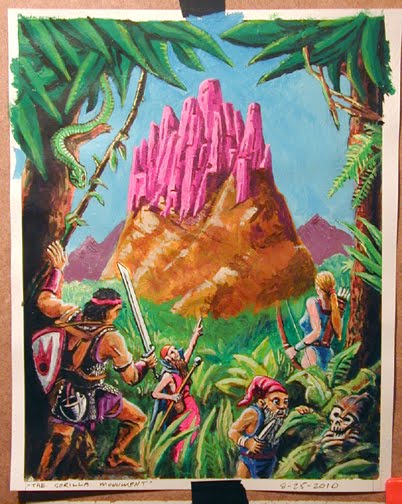
Some of you may remember the drama from August 30th where I screwed a commission and ended up with a painting I didn’t want. In the meantime, I have been working on revising the painting; this is a snap I took with my digital camera (at left). Please excuse the picture quality/color balance
It is currently in progress. In my first run at it, I painted the mountain in and changed the sky to blue… and the mountain had a rough face carved into it with caves where the eyes and mouth should be… but somehow I wasn’t really into that so I decided to revise again and put some sort of ‘otherworldly’ city on the top of the mountains.
When I did the sky in blue instead of the previous black, I had to paint over part of those fern fronds (which was a shame), so I’ll have to paint those again. I also don’t like the foliage at the top of the painting and want to introduce something there — plus the mountains and the mysterious city still need some work… and I want to add some more foliage and texture on the mountain itself as well as do something to move those distant mountain further into the background.
I’m having fun with it and look forward to finishing it as soon as I get some other projects out of the way. Looking at the painting, I’m enjoying being able to dream up a scenario or adventure to fit the painting, rather than coming up with the scenario first and then painting a picture to suit it.
Carriers (Movie:2009)
Posted: September 11, 2010 Filed under: movies, post apocalypse Leave a comment The other night I watched “Carriers,” an under promoted (and modestly budgeted) apocalypse flick that I really enjoyed.
The main characters are 4 young white 18 to 20 somethings who are travelling across the Midwestern US after a plague has decimated the population. Stars include Chris Pine (the actor who played Captain Kirk in the 2009 Star Trek flick), Piper Perabo (who looks familiar but I don’t know from what — although IMDB tells me she was in ‘Coyote Ugly’) and some others. Chris Meloni (who was on a gajillion Law & Order episodes) plays a father who briefly crosses paths with the refugees.
The premise of the film is simple: the four are a cohesive group who are determined to survive and they all practice a hygiene discipline that they hope will allow them to make it to an abandoned resort on the shore where two of the group (an older and younger brother) spent summers growing up. They don’t stop for strangers (because strangers might have the un-named disease that seems to have killed 90 percent of the population) and don’t touch anything unless they scrub it with antibacterial wipes and bleach. A few chance encounters and lies, however, sow the seeds of distrust in the group and they begin to turn on one another. This is probably less bleak than Cormac McCarthy’s The Road, but it still does not qualify as a feel good flick (i.e.: spoiler: there is no cannibalism — although you are treated to the sight of a German Shepherd chewing on the corpse of his previous owner). Issues of trust, family, euthanasia and whether or not the principle characters tell lies to protect themselves are dealt with in a fairly deft fashion.
There are ‘flashback’ scenes to the lives of the brothers shot on Super 8mm film that I felt got a little bit heavy handed, but that would be among my only criticisms of the film which I felt told a very effective story in a minimalist manner. Although Chris Pine probably qualifies as a ‘big movie star’ after his role as Captain Kirk in the 2009 Star Trek film, there are no big special effects or other spectacles that seem to be ‘de rigeur‘ in sci-fi, horror or dystopian fantasy genre films (any of which would be a fitting category for a film like “Carriers.”). It is this ‘economy of visual means’ that actually made the film more interesting. One never sees hundreds of corpses or shuffling hordes of the infected — a few blood stained pillows on empty beds and stacked body bags that look like a snapshot of post-Katrina New Orleans tell the story.
“Carriers” apparently had only a small theatrical release and then went straight to DVD, which is too bad; I’d like to see Hollywood work a little harder with less and rely more on dialogue and events than star power and spectacle to bring people back to the movies. I definitely recommend this film; although it is obviously not for the squeamish or all audiences.
The News about the News about the News
Posted: September 11, 2010 Filed under: news, politics 1 Comment While observing anniversaries of doubtful utility (9-11) and meditating on Koran burnings, mosque building and other examples of over-the-top battles of rhetoric, hyperbole and people getting carried away with their own self righteous indignation, I also found myself wondering how much ‘news’ is created by the act of reporting itself, especially in the age of the 24 hour access news cycle.
A pastor from Florida with a moustache that would make the Village People say “Wow” announces that he will burn some Muslim holy books on the 9th 9-11 anniversary. Years ago, this might have been a local news item at best — but today it’s picked up everywhere and suddenly everyone is giving this schmuck his 15 minutes of fame. Suddenly Mayor Bloomberg of NYC and President Obama and General Petraeus are weighing in and angry Muslims are burning American flags in the middle east as the American taxpayer forks over more money for heightened security around the globe. People are scrambling to get the story out and Pastor Jones (who I suspect is a publicity whore who finds the attention intoxicating) suddenly manages to expand the reach of his “ministry” from Gainesville, Florida to anywhere with internet.
I certainly support the right of Pastor Terry Jones to say what he wants (even though I don’t respect the content of his free speech and suspect the motives behind it). But there does not seem to be a ‘perspective control’ on the media. Suddenly this self serving bigot in Florida gets a microphone that reaches the far corners of the globe and seemingly everyone is interested in what he is doing and why. Even more annoying, Pastor Jones can keep himself in the limelight by making numerous announcements about the proposed burning. Initially he said he was going to burn the Koran, then he said the Koran burning was off, then he said he would not burn the Koran if Imam Rauf and his Manhattan congregation agreed to relocate their ‘Park Place’ Muslim center, then he said the burning was back on, etc. I can’t keep track of whether he intends to go forward with this stunt or not… but, then again, I find myself resentful that the story seems to have as big a news ‘footprint’ as it does.
My own opinion is that book burning a) no longer works and b) is stupid. If your intent in burning a book is to deny others access to the work itself, book burning was probably much more effective in the Middle Ages and earlier, when few copies of any book existed. When Bishop Theophilis burned the Library of Alexandria in 391 (if he was the one who burned it; Historians disagree), many of the books that were destroyed may have been one of a kind. But Pastor Terry Jones can’t possibly believe that burning a pile of Korans in Florida is going to prevent others from reading the book (especially since you can read the Koran (or ‘Quran’) online). In the age of mechanical reproduction (perhaps we have moved beyond Bejamin’s “Mechanical Reproduction’ and into “post-analog duplication” with the internet), burning a book becomes simply a symbolic exercise. The people who are “anti-book” can gather around their bonfires and toss the books they object to into the flames and the people who are “pro-book” can cluck their tongues in disgust and fire off screeds into the ether (as I am doing). But nothing changes, other than shallow opinions get more deeply intrenched.
Some older people may remember Patricia Pulling of “Bothered About Dungeons & Dragons” (B.A.D.D.) fame. As an anti-occult activist, she latched onto the Dungeons & Dragons game as the cause of her son’s suicide and launched a nationwide campaign that encouraged people to burn D&D books. I suppose a few cranks still believe her line of twaddle, but other than giving Patricia Pulling (and some other anti-Satan God-botherers) a certain measure of authority in the occult scare movement, they failed to accomplish anything of substance and the movement has largely been discredited.
Now that September 11 is here, hopefully Pastor Terry Jones and the other Koran burners will move quickly out of the news cycle and be forgotten; as they deserve to be.
(Getting ready to burn some books: Picture at right, Pastor Terry Jones of the Dove World Outreach Center being followed by a Hootchie mama with a Nine on her hip — Given the nature of the rhetoric the Pastor employs, I suspect the “Dove” in “Dove World Outreach Center” is not a dove of peace — perhaps it is a reference to “Dove” soap (as in, “We shall Cleanse the World!”))