Bass Ackwards Dungeon Design
Posted: February 12, 2011 Filed under: adventures, art, ideas 3 Comments Here is the normal order of things (at least as I know it):
The Giant’s Adventures: I love them
Posted: December 11, 2010 Filed under: adventures, campaigns, Dungeons and Dragons 4 Comments I love some of the earliest adventures published by TSR back in the day, but my absolute favorites are what I call “The Giant’s Trilogy” (includes “Steading of the Hill Giant Chief,” “Glacial Rift of the Frost Giant Jarl” and “Hall of the Fire Giant King,” (later the three were gathered into one adventure called “Against the Giants”)).
If you are accustomed to the modern “adventure path” style adventures, the first thing you will notice is how physically insubstantial the ‘Giants’ booklets seem in comparison. The older version comes in 3 skinny folders with maps printed in light blue on the inside (in the age of photo copiers, I think this color was chosen because 1970s era Xerox copiers had trouble reproducing it, thus TSR was probably attempting to prevent ‘analog age’ file sharing). There are no boxes of text to be read aloud to the players. Most creatures are not described with any more detail than their hitpoints (other details were to be found in the AD&D Monster Manual). The room descriptions mostly just tell you what (monster, treasure, furnishings) is in any labeled location and may include details like how they will react when player characters come strolling in or any traps or hazards that might be found in the area. Add a few wandering monster lists as well as some suggestions on tactics the giants will use as well as a ‘hook’ to get the players on to the next installment and that is it. The third in the series is a little more elaborate; it includes a couple of named NPCs who will be of interest (as well as introducing ‘The Drow’ to D&D players for the first time) and the suggestion that the adventure can be continued in the D-series of adventures.
The introduction to the first adventure, “Steading of the Hill Giant Chief,” consists of a pargaraph saying that giants have been raiding the lands of humans with greater frequency and unusual efficiency recently. The player characters have been ‘shanghaied’ into investigating; a greater plot is suspected and the player characters have been commanded to find out who is behind the attacks. If the players refuse, they are to be executed (how is that for motivation?). Any treasure the party can find is theirs to keep. The noble who gives the players this draconian assignment isn’t even named in the adventure. With that, players are led off to the nearby ‘Steading’ of the hill giants (kind of a stockade fort/cabin) and told to come back with answers.
If the players succeed in defeating the hill giants, they can move on to the icy caves of the frost giants. If the frost giants are defeated, then the players can proceed to the caverns of the fire giants. The giants have various pet monsters, traps and allies in their lairs, but the adventures consist of a lot of fighting.
So what’s to like about an adventure like this? I’ve heard fans of the 3e and later eras of Dungeons & Dragons dismiss this type of play as ‘hack and slash,’ and, if ‘hack and slash’ means killing monsters and taking their stuff, I suppose they are right. But other than being forced to deal with the giants, the players have complete freedom of action. From my limited experience, this is unlike the more modern ‘adventure path’ adventures where players usually have to first go to location A and talk to NPC B, then retrieve relic C and bring it back to NPC B, who will tell them that they then have to go to location D and defeat bad guy E… but bad guy E will escape, etc. The ‘adventure path’ reads more like a really long novel than what they thought of as an ‘adventure’ back in the mid to late 1970s. During that era, an ‘adventure’ was really just a location — and it was us to the players to provide the ‘inspiration.’
Progress Report
Posted: October 22, 2010 Filed under: adventures, art, Mines of Khunmar, project, publishing 2 Comments Work continues on several fronts. There is a floor mosaic in my front hall that needs more of my time (currently the tile ~75% done, then the grouting needs to be finsished).
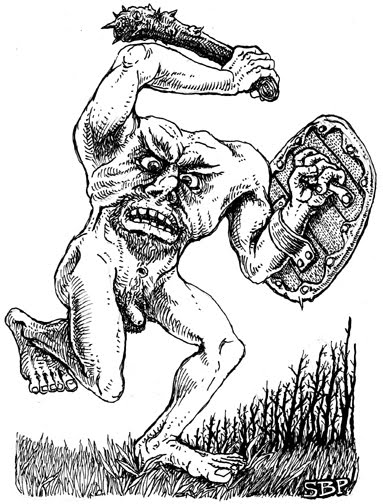
The Mines of Khunmar project has maps about 50-60% redrawn (I have the originals, I just need to redraw them all, then take them into photoshop to add legible type and numbers). There are a number of errors in the maps that I am correcting as I go along. After that, I need to work on the text and then do the artwork and layout — a daunting task. The image at right will possibly be included — this is the famous ‘crapper of death’ where those who stop to make a deposit risk being bit in the tukas by giant centipedes. Right under the ‘crapper of death’ is the famous ‘cesspit of death’ which I think may have caused 2 TPKs back in those halcyon days of my gaming youth.
I’m currently working on a fistful of illustrations for GameDevOnline. I’m probably upside-down as far as effort I am putting in versus money that will come out on this one, but the illustrations were interesting ones and I was enjoying to buckle down and really work these ones; I think I’m learning something new here and perhaps making some aesthetic discoveries, so its all good.
I have a new (old) project from a while back on which it is too early to say much other than, a) hopefully will result in a published piece; b) represents a somewhat unique idea as far as I know and c) will hopefully earn me some money if I can figure out where to place it. Still in the early stages, though. My one hint is that it deals with The Shaver Mystery.
I’m also still job hunting (sigh) which cuts into everything else. Plus I just finished winterizing our house, applying for a position at a local institution that took up a lot of time (and appears to have not paid off) and doing all the little jobs that now fall to me as ‘house husband’ (including cleaning, home maintenance, shopping, yardwork, etc.), so I have been a fairly busy beaver. But I continue to give an hour here and an hour there as I can; hopefully I’ll be able to make an honest effort to see Khunmar in print early next year, the mosaic finished before Christmas and my other (currently secret) project done some time in the new year.
Two New Freaks and removeable heads
Posted: October 11, 2010 Filed under: adventures, art, ideas, Mandeville, monsters, Oz, wierd stuff 2 Comments I’ve been sick as a dog for the past week with the worst head cold of my life, so I haven’t felt particularly inspired… but somehow managed to drag my sorry ass out of bed long enough to do a few things (including attending a 5 hour event at MOCAD — by the end of which I swear I was going to pass out).
First up is another creature in a possible series from Mandeville’s travels; a cynocephale (dog-headed man). Some of the period illustrations of the cynocephales showed them as having fur all over their bodies, others illustrations show them with fur only on their heads. I opted for the fur body — he isn’t wearing anything other than a bracelet. I had a hard time deciding whether or not to give him a tail, but none of the period illustrations I looked at had tails, so I left it off.
I’ve been using felt tipped markers on a sketch pad paper rather than my regular pen, brush and ink on Bristol and am still trying to get the feel for these new tools. One of the advantages is that I can work anywhere and traveling with a couple of felt tips and a pad is easier than needing a bottle of india ink, pens, brushes, cleaning supplies, etc. I’m less happy with this one than the picture of the Blemmye I did earlier — mostly because the legs look fucked up. But I like using a paper with a less smooth surface than the Bristol, although I miss the brush a lot.
 Next up is a headless zombie, and she’s coming right down the sewer tunnel at you! This is from an adventure idea I had based on one of the characters from “The Oz” series of books. In one of the books, there was a character named Princess Langwidere who had a palace in which there were cabinets containing many ‘swappable’ heads. Langwidere could just take her head off and replace it whenever she wanted with another head from her collection. When Dorthy Gale wandered into the picture, Langwidere decided she wanted Dorthy’s head and offered her another from her collection in exchange. I don’t remember quite how it turned out (other than Dorthy retained her head), but I always liked the swappable heads idea.
The adventure idea might be a city/town location where all female visitors are carefully inspected when they arrive at the gate… and, if they have an attractive face or a nice head of hair (or are even interesting or exotic looking), they are summoned to the castle for a royal audience where the Princess/Duchess/Baroness/etc., will demand they swap heads with her because she wants their head for her collection. She wouldn’t be interested in bearded female dwarf heads or tiny hobbit heads, but human or elven heads would probably strike her fancy.
I haven’t worked out how the heads are removed — perhaps a magic axe that severs the head without all the blood and gore and death? Then the user can just put the head on the stump of the neck and it sticks like Velcro. Langwidere probably wears some sort of a choker to cover the seam. I might rule that if you ever put your own “original” head back on, it will immediately graft itself into place and the only way to get it off again (without getting killed in the process) is to use the magic axe. If, after having their head severed by this magic axe, the user does not place a head of some kind on the body, they will eventually turn into a ‘headless zombie.’
One of the possible adventures could be that the party might either have to return to the palace to either free their female companions (who might be trapped in a dungeon for having refused to give up their heads) or they might want to break into the palace to retrieve the original head of their female companion if they have been forced to relinquish their original head.
One of the ways into the castle is through the sewers… but the sewers are inhabited by the animate corpses of the Princess’ former enemies or women who made a nuisance of themselves by demanding their heads back.
MINES OF KHUNMAR to be published (soonish I hope)
Posted: October 1, 2010 Filed under: adventures, art, creativity, Dungeons and Dragons, Mines of Khunmar 12 Comments A few years ago I released a pdf of notes and maps (about 5 mb — 50-60 pages) of a “megadungeon” of my own creation that had been ‘under construction’ since 1980 or so. It got some approval from those who like big-ass dungeons, like here… or here… or elsewhere.
But the initial release (in 2004), although free, was just a scan of about 90% of the maps (eight levels; each level consists of around 2 to 5 maps) and very brief summaries (written by me) of what was on each level. It was just an outline.
Enter Geoffrey McKinney. He downloaded the ‘outline’ and wrote me to say that he wanted to see it printed. I hemmed and hawed and whined that the original notes were all written in pencil or ink on school notebook paper with lots of abbreviations and cross-outs and spelling errors and my handwriting was crap anyway, so he said that if I scanned the pages, he would type them up and send me an MS word copy. I took him up on his kind offer.
About a year ago, one of the OSR publishers approached me to ask if I would like to see Khunmar go to print. We had some discussions, but after a year we hadn’t made much progress, and, since I have been out of work for a while, I decided that if ever I was going to have time to work on Khunmar, it would have to be now. Previously I had released ‘Exquisite Corpses’ via Lulu and had been pleased with the way that worked out.
So I’ve decided to publish it myself. Whether via Lulu or some other means is still in doubt. I haven’t figured out what set of rules I should make it compatible with, but I’m guessing I’ll just make it as close to ‘generic D&D’ as I can using a rule set like “Labyrinth Lord” or similar.
This is a massive undertaking. So far, without maps or much editing, the manuscript runs over 100 pages. The maps are all poorly drawn in pencil on yellowing graph paper and need to be redrawn. I’d like to use the book as a showcase for my illustration and will be illustrating it myself with scenes of adventurers in the dungeon itself (the picture above is my rendition of one of the encounters involving a giant cyclops and his pet hydra that I painted for my own amusement). I would also want the book to be interesting for the other dungeon masters or mega-dungeon fans to read, so many of the entries (which consist of just the name of a monster, hitpoints and treasure, if any) have to be written and ‘fleshed out.’ There are also lots of errors: missing levels, stairs that lead nowhere, mislabeled rooms, etc. An unrealistically optimistic estimate would say that the earliest it will be even close to being ready for print is a year from now.
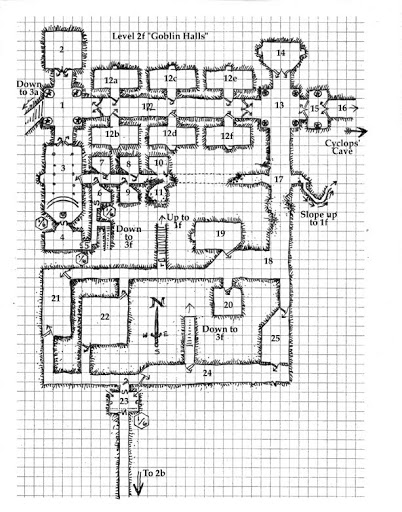
But I’m excited and eager to see it through. As an example of how I would like to see the maps done, I’m attaching one of the maps (level 2f) below. Click to see an enlargement.
Welcome To Aldeboran
Posted: February 28, 2010 Filed under: adventures, campaigns, creativity, Dungeons and Dragons, fantasy, games, picaresque, project 1 Comment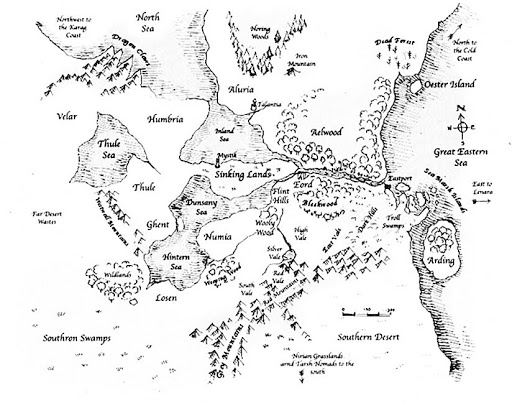 I have been calling my campaign world by several names over the past years — at one point it was ‘The Vales’ since there were different regions (Silver Vale, Red Vale, East Vale, etc.,). It has also been called ‘Hinterlands’ or ‘Northlands’ since most of the action took place is an area that was considered remote and removed from the more ‘civilized’ lands to the south and east. I also called/call it ‘Aldeboran’ (after the sun that the earth-like planet revolves around) or ‘Tellus’ (after the planet itself) but I go back and forth between wanting it to be a planet as an astronomer might define one… or just a ‘world’ which might just be a bubble in space, or moss on the back of a giant turtle… or a clump of dirt floating in space or whatever.
‘Aldeboran’ is an alternate spelling of ‘Aldebaran’ which is an actual orange giant star only 65 light years from Earth and in the constellation of Taurus. The name is arabic and apparently means ‘The Follower’ because when observed, it appears to follow The Pleiades. Lovecraft associated Aldebaran with Hastur, one of his ancient gods, so the name seemed apt.
Most of the action takes place on the large continent divided into several smaller kingdoms. Some of the places are Lenaria — an ancient empire to the east which once rules the Hinterlands where most of the action has taken place. Lenaria was 90% destroyed by meteors a few hundred years ago (or was it fire from the sky — or even some sort of stange curse or magic or weapon?) but the Lenarians still dabble in powerbrokering in the new world (they are a rip-off of the Melniboneans from Moorcock — powerful sorcerers with gigantic galleys, armies of slaves and dragon air cavalry, they worship the Dragon Goddess). The remaining islands of this once mighty empire share the names with German photographic lens formulas of the late 19th/early 20th century (Thambar, Xenar, Tessar, Summar, Summitar, Noctar, Elmar, etc.).
South of Eord lie the Vales, including Red Vale and The Red Mountains… home of the dreaded red dwarves (who are cannibals who consider everyone else as potential food). North lies a forest kingdom of Elves (named, quite unimaginatively, Alfheim), and Aluria, a kingdom of Amazons as well as other various wastelands. There is also a large swampy land known as ‘The Sinking Lands’ which is ruled by a very powerful magic user… and to the west lies Thool (or Thule) which is ruled by a priesthood who have evolved (or devolved) into creatures with enormous brains and frail bodies. Of course, they maintain armies of lesser intellects to serve and protect them. There is also the ruined city of Tana Tak, which is said to be overrun by flesh eating ghouls, but great ancient secrets are said to be buried deep beneath the ground. There are various other kingdoms, some swamplands to the south (which are littered with gigantic stone statues rumored to be the petrified remnants of gods).
THE HORRORS OF IT ALL!
Posted: February 7, 2010 Filed under: adventures, art, comics, creativity, inspiration, picaresque, reviews 1 Comment