A to Z: K is for Khunmar!
Posted: April 12, 2011 Filed under: A to Z, adventures, Mines of Khunmar 3 Comments Today is brought to you by the letter K.
Khunmar (as in “Mines of Khunmar,”) starts with the letter K. Khunmar is my magnum opus, my megadungeon, my Castle Greyhawk, my Castle Blackmoor, my Stonehell, my Castle of the Mad Archmage…
The fellow at right has discovered why you should ‘go’ outside rather than dump a load in Khunmar.
I am definitely repeating myself here, but, in case you did not know, Khunmar is a big-ass dungeon drawn on graph paper, sheets of notebook paper, etc. I started it in the 80s, kept adding to it over the years and now it remains, a testament to the fact that for much of my teenage years I did not have a life. Fastforward a few decades. I found the binder in my parent’s attic. “I still have this?” I took the maps with me and scanned them, then wrote out brief outlines of each level and put them together in a pdf that I released for free over the series of tubes we call the internets.
Since there were around 8 levels (each level occupies an average of 2-5 sheets of graph paper) and lots of side and sub levels, the low res document was about 6 mb in size. People liked it.
Geoffrey wrote me and said how much he liked the dungeon and offered to type up my handwritten notes. Every few weeks I would scan a couple pages of my chickenscratch and email it off to him and he would patiently puzzle out what I had written 20+ years ago and type it. I think it took him a year or even two to finish that thankless, Herculean labor. Then a publisher (I’m not sure if I should refer to them by name so I will err on the side of caution) expressed interest in publishing it. For one or two years we exchanged emails but nothing happened. Somewhat frustrated but with no malice, I finally wrote to them and said I thought they should either commit or I would pull the project and try to do it on my own. They expressed regrets but indicated they were more interested in another megadungeon that wasn’t Khunmar, so, to my regret, we parted company.
This leaves me where I am now. Every six months or so I blog about “this is the year I will finish and publish Khunmar!” and then another six months go by before I work on it again… but, now that it is such a huge undertaking and 100% on my shoulders, I find myself a bit overwhelmed and undersupplied with time to give Khunmar it’s due. So I am somewhat leery of making any promises at this point other than to say that although not much progress has been made since my last post on the subject, I have every intention of finishing Khunmar… I just don’t know when.
A to Z: H is for Hook Horror
Posted: April 8, 2011 Filed under: A to Z, adventures, aldeboran, monsters 4 Comments H is our letter for the day and today I will talk about “The Hook Horror” from the 1981 Fiend Folio. Fiend Folio is one of those books that I didn’t like when it came out because all of the critters in it seemed so weird and useless and lacking in logic… and then I grew up and stopped taking it all so seriously… or something like that. The hook horror lives in caves, is 9 feet tall, moves at 90 feet per turn, has an AC of 3 (which is pretty good) and has 2 attacks per turn that inflict 1-8 damage each. Weighing in at 5 hit dice, it is a little tougher than ogres (4+1 hit dice) and a little weaker than giants (8+ hit dice or more, unless you are talking about those pathetic Verbeeg). It bothers me that the hook horror is not described as being able to peck or bite with that massive beak (in the picture, his beak is bigger than his hooks). I’m thinking that would be something I would change with a house rule. The hook horror is nearly blind but has excellent hearing (therefore turning invisible won’t help you — HAH— but your magic user might find a use for that audible glamer spell). They communicate by clicking their exoskeletons. This makes them sound like they are insects, but in the drawing they look like a double-hand-amputee in an evil chicken suit. I actually like the drawing so I wouldn’t change that… even the lumpy sweater-vest and panties that the hook horror is wearing.
  Guard the rear! Your henchman has just been trepanned by a hook horror!

A to Z: G is for Gamma World
Posted: April 7, 2011 Filed under: A to Z, adventures, aldeboran, gamma world 1 Comment This fascinating article from Outside Magazine by Henry Shukman describes a trip to the Chernobyl “exclusion zone” in The Ukraine more than twenty years after the reactor exploded.
Shukman describes how the area around Chernobyl has returned to a state of near wilderness. Elk, wolves, wild boar, lynx and other animals not seen outside of zoos in this part of Europe have returned and are prospering. The towns within the exclusion zone were abandoned right after the reactor failed and nature has been taking it all back; wood rots, iron rusts, ice and roots crumble away the asphalt and concrete.
But the exclusion zone might also be the world’s biggest unguided experiment in genome mutations. Researchers have discovered many species of plants and animals that are changing in unexpected ways. Some birch trees within the zone resemble tree-like giant feathers rather than the common birch tree. Bird populations exhibit unusually high rates of albinism. Animals inside the exclusion zone have higher levels of cancer than animals outside the zone.
Meanwhile, the ‘containment’ structure that was built over Chernobyl #4 (the reactor that caught fire) has begun to fail and the expected replacement structure is overdue. Engineers claim the containment structure was never adequate to begin with. In Japan, problems continue to plague the earthquake and tsunami damaged nuclear plants.
I’m not sure whether to be fascinated or scared to death.
A to Z: D is for Demons
Posted: April 4, 2011 Filed under: A to Z, adventures, aldeboran, monsters 1 Comment Today, D is for Demons. One of the delights of monsters like demons (and devils) is that they can seemingly be so diverse in appearance without raising any eyebrows (if they have eyebrows). Check out the third figure from the left in the picture at right: he has a bird face growing out of his ass! How does that work for him? I don’t know. But it would make sneaking up behind him somewhat difficult. A few years ago I was thinking about the demons and devils I might use for Aldeboran and I considered making them all unique. Perhaps forms, features and special abilities could be randomly generated. I didn’t pursue it any further, but that idea is still on the work bench.
A to Z: C is for Cylons
Posted: April 3, 2011 Filed under: A to Z, adventures, aldeboran, monsters 5 Comments This will probably interfere with my credibility in some people’s eyes, but I am one of those misbegotten assholes who actually prefers the newer Battlestar Galactica to the original series. I know that this is treason. The original aired the same year I started playing D&D (1978) and featured monsters, ray guns and all kinds of other stuff — I just don’t remember it very well, and what I do remember involves a dorky little kid and a robot dog. The original cylons were cool, though. Even when they photographed them through the magic ‘star filter.’ Photos taken through star filters always look cheesey and kind of porn-y… I suppose if robots give you wood, that is a good thing… but speaking of robots giving one wood, have you seen the Svedka Vodka commercials with the dancers and sexy robot? They just freak me out and make me never want to drink Svedka.
C is for cylons. In Aldeboran, I want to have cylons. Why they are there and what they are doing I don’t know yet. But there will be cylons. Some of them will be clanky ones that look like a dude in a suit (see at right) with a red eye that goes back and forth like he is watching a ping pong match. The one in this picture even has a sword! I don’t remember if they had swords or not in the original series. Others will look just like people. Fuck! Maybe they will think they are people and get freaked out when they find out they are cylons! I also want to have a ‘war of the worlds’ bit, but I don’t know if that will be related. Maybe I will wait to talk about ‘War of the Worlds’ when we reach W.
A to Z: B is for Bandits!
Posted: April 2, 2011 Filed under: A to Z, adventures, Dungeons and Dragons, monsters 1 Comment Today’s letter is ‘B.’ B is for ‘Bandit.’ I’m not talking about the dog who accompanied Johnny Quest… nor am I referencing the CB handle of Burt Reynold’s character in “Smokey and the Bandit,” but unlawful types who lurk in the wild places of the world and rob others.
Pages from the Yaqqothl Grimoire
Posted: March 16, 2011 Filed under: adventures, OSR, publishing 1 Comment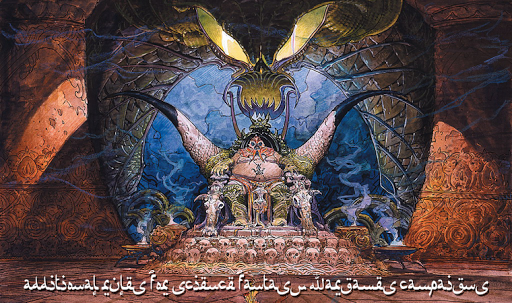 Nicolo (of The Yaqqothl Grimoire) is putting out a fanzine for Old School Games and I will be doing some illos! Tentative title is “Pages from the Yaqqothl Grimoire.” Look for it in April/May.
From his message to me describing the blasphemous book:
The zine will include:
– three new classes (barbarian, goblin and ghoul) and a revised thief
– rules for laser weapons in A/OD&D
– some new spells
– and a complete, tiny, lovecraftian sandbox, featuring Tower of the Re-Animator (a full adventure), a really weird jungle and an Innsmouth like village (complete flashed out)
I’m not certain how to pronounce “Yaqqothl,” so I am going with “Yah-kaw-thil” till I find out otherwise.
(I did not draw this cool illo; it’s from Nicolo’s blog header and I really like it. Look at that spooky evil fat bastard!)
Aldeboran
Posted: March 14, 2011 Filed under: adventures, aldeboran 2 Comments
Yesterday The Day before yesterday I posted some stuff about my homebrew world. I wasn’t posting it to propose a new game for me to participate in or run; I was just trying to distract myself with some wool-gathering on more pleasant topics than the class warfare that dominates Wisconsin and Michigan right now, or the tsunami in the East or the perfidy of American politicians and corporations…. I was trying to distract myself with more pleasant thoughts, even as I get ready to pay my yearly taxes (groan — I don’t mind paying, I just wish the powers that be did something better with the money).
At right is a map I made many years ago and upon which I set many campaigns. Compare it to yesterday’s map of the same continent (somewhat revised). I actually feel like I have A.D.D. when it comes to this map — I’ve redrawn it several times, and, for my ‘world building as occasional distraction’ thing, I’m not sure which version I would use.
As an introduction, in the center of the map is ‘Catatonia’ (“Catatonia” was a reference to the mythical geography of a parody of World War 2 in one of the episodes of ‘The Three Stooges’ (along with ‘Moronica’) rather than a reference to the the Welsh power pop group). The capital of Catatonia, the city of Eord, is one the shore of the Strait of Belar just below ‘The Sinking Lands’ and west of Bleekwood (on some maps renamed Blackwood) forest. Eord is my world’s ‘Blackmoor’ or ‘City of Greyhawk.’ It is one of those cities with a lot of traders, alchemists, guilds, etc., and is also the home to ‘The Golden Palm,’ an inn where many adventures start. Eord is also the location where the grandmaster of The Red Hand (an order of assassins) supposedly has his office (or her or it’s — no one is really sure…) . The famed adventurers, Karrl and Bluddo, usually can be found in Eord between adventures.
South of Silver Vale (Nibblot is in Silver Vale) lies ‘The Valley of the Fu.’ The Fu bird is a gigantic multicolored creature who causes misfortune to all who see it… usually by shitting on them. In this vicinity are also East Vale, Silver Vale, etc.
 The Red Mountains (also in this vicinity) are home to the dreaded Red Dwarves… who are cannibals and thoroughly unreasonable savages who fatten themselves up by devouring all of the poets and landscape painters who come to be inspired by the scenic beauty of the Silver Vales and Red Mountains at dawn or dusk. Their tattered composition books, rain-soaked canvases with broken easels and well gnawed bones can be found if you check the underbrush near the popular ‘look out’ spots.
 Northwest of Eord are ‘The Sinking Lands.’ These swampy lands are run by the Archmage of Mystik (that is the name of his town). Years ago we had a pasteboard model of ‘Mystik Seaport’ in Connecticut and I had always intended to use the little paper buildings as a setting since they were approximately the right size(we also had paper models of The Alamo and Monticello), but I never did and have no idea what happened to the paper models. The sinking lands are home to all sorts of monsters. On my older map, the City of Mystik seems to have been located in The Southron swamps but at some point I moved it to the Sinking Lands. Mystik and Eord have an uneasy relationship… mostly because while the Archmage is not an unreasonable person, most of his subjects view the humans and demihumans of Eord and The Vales as ‘food.’ Sometimes it sucks being human.
My Favorite Adventures
Posted: March 13, 2011 Filed under: adventures, creativity, Dungeons and Dragons, project 1 Comment Planet Algol is asking for reader’s favorite adventure recommendations, but, speaking as someone who has enjoyed making up my own adventures almost as much as running them, I thought I would describe a few of the favorite adventures that I made up in broad strokes.
(at right, my illustration of one of the encounters in my megadungeon, “Mines of Khunmar”)
1) Mines of Khunmar: One of the advantages of making up your own is that you can be a lot more cavalier about the details since you will usually know what you mean and the briefest of notes will usually be sufficient. Years and years ago I created a ‘megadungeon’ in the old mode (like the dungeons of Castles Greyhawk and Blackmoor). Even after I stopped playing D&D, every once in a while I would look this thing over, sometimes adding a little more. It’s been decades since I have hosted an adventure in Khunmar (an outline version is floating round the internet). Khunmar has seven or eight main levels, many sub and side levels, etc., and consists of 30 to 40 maps, each with an average of 25 or so numbered locations. My rational was that Khunmar, like Tolkien’s Moria, was originally a dwarven mine/fortress which was subsequently abandoned and overrun by humanoids after the dwarves ‘delved too deep.’ The upper levels have areas controlled by goblins, kobolds, orcs, undead, etc., and nastier creatures lurk below.
Geoffrey (occassional reader of this blog) took scans of all of my handwritten notes and typed them up and I keep telling myself that I will use that to create a finished product; the only question is when.
2) Gastan’s Gold Mine: I created Gastan’s Gold Mine for my players back in the early 80s. The gold mine was accessible from 2 points: either down a well on an abandoned farm or through a cave occupied by a cave troll and over an underground chasm. The mine was infested by the animate bodies of dead miners, dead adventurers and dead goblins who were all infested by a black mold that animated them like zombies. If you were struck by a zombie, it was likely that you would be infested too (and eventually become a black mold zombie). Since the zombies were animated by mold, they could not be turned by a cleric (although I suppose a ‘control plants’ spell might work; the players never tried that). The zombies couldn’t cross the chasm or climb out of the well, so the mold zombies could not infest the surrounding countryside, but the body count from the mine (and the troll) was very high indeed. Large numbers of valuable gold nuggets could be looted from the mine but I think only 1/2 or less of the players made it out alive. The victims joined the other ‘mold zombies’ in the mine.
3) Marshville: I always liked the Lovecraft story, “Shadow Over Innsmouth,” and created my own ‘deep one hybrid’ community for D&D I called Marshville. The players arrived in town and found the locals ugly, stand-offish and unfriendly. The towns resident drunk drops some ominous warnings before the locals slip him a mickey to shut him up and they make contact with a local old wise woman (one of the few pure humans left in town) who warns them to ‘get out while they can.’ They eventually got into a fracas with the locals and discovered that some of the towns older residents were more and more ‘fishlike’ and the residents of some of the older residents are equipped with bath tubs that the locals use as ‘beds.’ Eventually, the deep one hybrids turn pure fishman and retreat beneath the waves (I placed a temple underwater but never got around to designing that part of it but the players never went there anyway) There are tunnels and chapels to a perverted sea god under the town that the players explored and they employed hit-and-run tactics against the locals until finally having to leave town via a teleport spell since all of the residents (full fishman and still able to pass as human) were after them.
One of the peculiarities of the adventure is that the players left town with an unusually large number of magic tridents.
4) The Haunted Monastery: In my own homebrew world, I have a religion I call “The Allfather.” The Allfather’s followers are somewhat like the medieval Catholic Church; basically lawful but inclined to an excess of zeal and dogma. When local authorities make it possible, the Allfatherians persecute or forcibly convert non believers and some races (like elves) are declared an ‘abomination’ while others (like dwarves) are tolerated as second-class citizens who can never attain ‘grace’ through the church. The Allfatherians seek to form a theocracy with their clergy as rulers. The players happened upon an apparently abandoned Allfather Monastery high in the frozen mountains while attempting to lead a group of human slaves liberated from an underground village of goblins to safety. The monastery appeared empty and the slaves were freezing because they lacked food and clothing, so they took shelter there. A single monk, apparently mad, committed suicide by jumping out a window. The players discovered that there was an ancient crypt deep beneath the deepest cellar of the monastery that the monks had discovered and the monks were all gone because they had released a plague of undead as they sought to expand their beer cellar. The most powerful ghost was one that could freeze anyone who stood in proximity to it and drive people mad with his babbling. While there, one of the players picked up a cursed mace and then secretly began murdering the rescued prisoners (the other players had no idea that this was going on and assumed that the ghosts/zombies/ghouls were doing the killing).
OSR FOR SALE
Posted: March 6, 2011 Filed under: adventures, art, Dragonsfoot, Dungeons and Dragons, OSR 6 Comments Rob Conley has been writing about ‘The Commercialization of the OSR’ over on his blog, “Bat in the Attic.” In his posting, Rob references Mythmere’s useful analysis of the history of the OSR (here and here). I’m still digesting both Rob’s and Mythmere’s posting, so I hope this post does not come off as me as attempting to ‘refudiate’ what either of these people have said. One of the issues that strikes me, however, which may be tangential to Rob’s and Mythmere’s posts, is the idea of the ‘virtue’ of free OSR product over ‘for pay’ product in the OSR. A number of pretty vocal people tend to spout the sentiment that ‘all OSR stuff should be free’ whenever OSR product for pay is mentioned.
 One of the primary arguments advanced by the ‘anti-sales’ contingent is that many of the products offered for sale are not worth the asking price. Of course, this sidesteps the religion of capitalism (the market will decide if products succeed based on people voting witht heir wallets). But “quality” is a relative thing, isn’t it? Back in the day, we had a lot of fun with adventures like “Thieves of Fortress Badabaskor.” As far as the usual markers of quality goes in terms of completeness, adherence to the rules as written, professionalism of layout and art, etc., etc., “Badabaskor” seems pretty “bad” by the standards of most products (even free ones) today. Some of the art is pretty amateurish, the spell casters do not have spells listed, many things are not explained adequately and there are editorial mistakes galore. Despite this, we had a lot of fun with that adventure. In some ways, it’s incompleteness was almost a virtue since the DM seemed to have a lot of fun filling in the details. So was it ‘worth’ what we paid for it? I’d say if the value of such a book is in the fun that you get from it, the answer is “yes.”
 I have to confess that I had some pretty frustrating experiences with publishing a ‘free’ OSR-type adventure through Dragonsfoot. I submitted an adventure for ‘free’ publication a number of years ago and waited for about two years for someone to get around to reading/editing it. It was only when I said I wanted to take the adventure elsewhere (since I thought it would never see publication) that it got pushed into publication. Then, when it was in editing, I had a number of editors demanding I make changes that I did not neccessarily want to make or agree on. One editor was quoting rules from one of the rule books in his messages to me in a manner that kind of galled me, especially since I had written the adventure years before and based the adventure on how I had ruled or interpreted rules. Finally, as author I wanted to also illustrate the adventure, but at one point the editor sent the images back to me, saying they looked like ‘crap.’ I had done the illustrations in black and white and then added a ‘zipatone’ texture digitally. The editor demanded I remove the zipatone texture because he didn’t like it. What disturbed me was that the editor seemed to be under the impression that I didn’t give a shit about how it looked when I felt like the whole project was really MY BABY and he was just the midwife who was really supposed to make sure we dotted the i’s and crossed the t’s before we sent it out.