Session 10 (Jon’s DCC Game)
Posted: October 18, 2012 Filed under: adventures, campaigns, DCC RPG Leave a comment
Session 10 10.17.12
(P)tarth: wizard and portal master(Kevin), accompanied by his french Familiar (Imp named Ganbon)
Abattoir: hobbit and luck-providing bobble head(mike C.) (Ok, abattoir is not really his name – It’s ‘Abathon’ or something like that).
Kreglar: Priest of Cthulhu (or something like that) (Dave M.)
Soltar the Evangelist: Priest of Arestimus (Dave P.)
Marlowe: Elf (stef)
Almuric: thief and masked avenger (Reuben)
We reviewed our rumors as (P)tarth climbed up onto the roof of the gatehouse via a ladder to inspect the portcullis. We recalled that there were rumors telling us that a fantastic treasure could be found under the tower, stay away from the well, the keep was originally built by a pair of brothers who were chaos lords, etc. As we did this, (P)tarth lowered the portcullis and cast ‘ward portal’ on it. He was upset with us for having retreated ‘too early’ last time when we were sprayed with pumpkin seeds and plant zombie spoo.
Having had our egress cut off, we advanced a bit into the soggy courtyard. The west wall of the castle had collapsed and the gatehouse was somewhat ruined. There appeared to be some ruined buildings on the north side of the castle and a large building to the east that was decorated with toad-like gargoyles. There was a pit in the northeast corner that appeared to be filled with mist, a well in the center of the courtyard and a tower in the southeast corner. Last session one of the monstrous sentries had run into the tower in the southeast corner via a small door that gave access to the parapet on the walls.

We then argued over whether or not we were going to press on or wait for Sotar the cleric. The vote was 6 to 1 against waiting (Marlowe wanted to wait because Sotar appeared to actually be able to heal people, a feat that the other cleric, Kreglar, had only accomplished once). We then proceeded down the steps to the north that led to deep under the castle, Marlowe the elf and the hobbit going ahead (with infravision) and the rest a distance behind with torches. (P)tarth declared that if anyone surprised him, he would, without hesitation, blast them with a color spray.
“Did you miss me?” shouted Sator the cleric, as he came clumping down the steps.
“Shhhhhh!” said the hobbit. He and the elf had seen some gold coins on the steps below and suspected a trap. Who leaves gold coins on the stairs? Almuric used his thiefly skills to investigate. The coins were real and normal, but there was a rough passage to the left and a secret door to the right. The steps continued down into darkness. Almuric opened the door and found a small chamber with three obviously looted chests in it and a sprinkling of coins on the floor among some beast-man like tracks. One of the chests had a false bottom that contained a silk tabard adorned with a symbol of chaos (which Almuric put on), a steel vial of some sort of liquid …”and two, no, excuse me, one silver ring…” said the wily thief. We split up the coin on the spot. Overcome by curiosity, Marlowe tried the potion and felt stronger and more powerful (a potion of cocaine!).
Session ended here.
More Megadungeons
Posted: October 16, 2012 Filed under: adventures, weird 2 Comments |
| Put a few bones or a torch stub in it if that will make you feel like it’s more exciting. |
Megadungeons: I can no longer keep track of who said what or when or why, so I won’t pretend that I even know anymore… but I think there is still some juice in this topic, so I’m going to keep at it.
As anecdotal evidence, reading Evereaux’s campaign journals, it certainly sounds to me as though they had fun… so I guess I’m a bit skeptical that some declare the megadungeon to be an automatic recipe for a snore fest. On the other hand, I think successful social events are successful because there is a willingness on the part of the participants to participate. As an example of an unsuccessful social event, I would offer up the story of ‘Jack and the koosh ball.’
Baedeker’s Guide To The Northlands: Eord
Posted: October 8, 2012 Filed under: adventures, aldeboran, Baedeker's Guide to the Northlands, campaigns 1 CommentNote: Travellers in Aldeboran are advised that while the authors have made every effort to provide the most accurate and up to date information within this guide, the Northlands region of the continent is subject to periodic political, cultural and genocidal upheavals. Although this constant state of flux makes Aldeboran in general and The Northlands in particular a very diverting place to visit, risk to life and limb on the part of travellers to this fascinating region should be assumed as a given, not just a possibility. Protection in the form of magical wards, armed guards and escape spells are not to be considered ‘optional’ by the traveller who wishes to survive the trip.

EORD (variant spellings: ORD, ORRD), City of: Called ‘The Jewel of the North’ by her admirers, this ancient city is currently ruled by Lord Mandras Delayn. Lord Mandras assumed the throne under a bit of a cloud following the mysterious disappearance of his predecessor, Lord Glarion. The majority of Glarion’s heirs and relatives (with the exception of his cousin, Mandras) either found reason to be elsewhere when the succession was announced or vanished to such a great degree that neither well trained bloodhounds nor divination magics could locate them. Perhaps it goes without saying that the writers of this guide think that Mandras is a wonderful, magnificent monarch and Eord is lucky to have him… and our writing that has nothing to do with the relative talent of the king’s inquisitors nor the dampness of his dungeons.
The history of this ancient city predate the Lenaran conquest and subsequent dissolution of the famed and feared Dragon Empire. During the years of Lenaran rule, a city and garrison was established by the Imperials. Following the great Lenaran Catastrophe and the Hinterlandian revolt, the city and garrison became the seat of Alberc, now called ‘the First King’ (even though he really wasn’t — like many of the ‘young race’ residents of the Hinterlands, the Eordians consider history as having “started” when the Lenaran Catastrophe occured). Before the arrival of the Lenarans, a trading center is known to have stood on the site and, based on archaeological evidence, seems to have traded hands (or paws or claws) several times over the eons. Portions of previous fortifications which have been incorporated into the city’s current defenses and might be described by the architectural enthusiast as ‘cyclopean’ are probably a “must see” for the serious tourist who wants to understand the city’s origins.
The City of Eord is also the focal point of the defense of the Eordian kingdom against swampy Mystik and The Sinking Lands, their near neighbors to the north-west, and is strategically situated to offer a ready port to the Strait of Belaring, the Inner Sea and the Dunsany Sea. As a result, the ports and docks of Eord will be filled with the vessels of many nations, giving the city an appealingly multicultural aspect.

The City Proper: Avoid the slums and slaughter yards to the south. Although beds, beer and board might be cheaper than within the city proper, the ‘inns’ you are likely to find here will usually consist of places where watered beer and stale bread is served and the beds (if availible) will be flea-infested mattresses with soiled sheets. Historically, the periodic attacks upon the city usually result in the destruction of the dwellings outside the walls, so structures in this area will be of wood or wattle and bear no historical or aesthetic interest.
Eord City proper consists of a series of ringed walls, and the general rule seems to be the further you penetrate the encircling walls, the more magnificent the structures. The innermost ring contains the palace, also known as Castle Eord. Outside of that, one finds the noble quarter. The noble quarter, in turn, is surrounded by ‘The Merchant’s Quarter (also known as “The Old City”). The outermost ring is known as ‘The Commons’ and is generally considered to include the seafronts and docks.
Castle Eord: The palace (well, a ‘palace’ by Eordian standards; proper Lenaran nobility would turn up their finely chiseled noses at the idea of this structure being termed a palace) which currently stands upon a promontory known as ‘King’s Hill’ in the center of the city is much expanded from the structure that King Alberc re purposed from the previous Lenaran governor. Frequent mention is made of layers and tunnels beneath the palace which predate even the Lenaran occupation and, perhaps may even predate the arrival of humans in the Hinterlands but the veracity of these claims cannot be verified, especially since the palace in general (and the dungeons in particular) are not open to visitors. Most ‘tours’ of the dungeons tend to be a last stop for the unwilling ‘tourists,’ and, despite the fascinating history to be found there, investigation of the palace or dungeons is strongly discouraged. Although portions of the palace might catch the interest as particularly well preserved examples of pre-catastrophe Lenaran territorial architecture, they are best admired from a distance. The structures are picturesque, but artists who have attempted to capture their glory on canvas or in a sketchbook have also brought unwelcome attention upon themselves from the inquisitors; the artistically inclined are strongly encouraged to choose other views.
Temple Quarter: Any visitor to Eord should plan on devoting at least a day or two to exploration of ‘The Temple Quarter.’ Found in the eastern part of ‘The Old City,’ this quarter is dominated by ‘The Street of The Gods’ which stretches from Old City’s East Gate to the Noble’s quarter. Many of the structures are among the oldest in the city and may even predate the Lenaran occupation, although temples tend to change hands fairly often so establishing the exact provenance of one structure or another may be difficult. A description of a few of the more popular temples and their worshippers follow:
- Temple of The Rat: Tourists are advised to tour this temple in the day; at night, the increased presence of vermin can be somewhat off-putting. Located on the north side of the street near the Eastern Gates, the Temple of the Rat has a long history. It can easily be spotted since the structure itself is adorned with thousands of carved representations of rats. Crowds assemble almost daily for sanctioned sacrifices which usually involve the tossing a live goat into the rat-filled sacrificial pit; persistent rumors tell of invitation only events where less prosaic sacrifices are offered, but one shouldn’t credit everything you hear. Sources disagree as to weather the large rubies used as eyes in the statue of the Rat God are real or fake.
- Temple of Yth: Now closed due to the execution of the priests by Lord Glarion more than twelve years ago, the Temple of Yth still presents an imposing edifice. The front of the temple is of pale green stone rumored to have been imported at fabulous cost from old Lenara and the cast bronze doors are a work of art (although the subject matter, which involves the Serpent God devouring sacrifices, may be considered a ‘bit strong’ for some audiences). Note the gilding (now, sadly peeling) on the domes. Rumors persist of fantastic mosaics within the temple, but, given that the practice of Ythianism has been outlawed locally, no arrangement to tour the interior is currently available. Despite being located on a prime bit of real estate, the temple still stands empty.
- The Followers of The Bleeding Head: The followers of The Bleeding Head can be easily recognized within the temple quarter since many of them practice frequent devotional blows to the forehead with a mallet and/or the wearing of thorns as a crown. The cognoscenti consider this ‘cult’ an annoyance, but one cannot deny that their followers are the model of dedication. Their temple is a fairly modest structure of little interest to the student of architecture, but the followers of the Bleeding head do most of their worshipping/proselytizing and forehead malleting in the street itself.
- Temple of the Allfather: One of the most powerful new religions in Eord and surrounding countries, the Allfatherians are also noted for their lack of tolerance towards elves, dwarves and other ‘demi-humans.’ Although Eordian law does not permit persecution of demi-humans, the Allfatherians are not shy about making their displeasure with ‘unclean’ races known. Elven, dwarven, gnomish and even halfling visitors are advised to avoid the main temple (decorated with a red cross on a white banner) or any large gathering of Allfatherinas (usually bearing banners with the red cross on white or wearing tabards of a similar pattern).
- Temple of Umma: Although Umma (the She-He or Sister-Brother) has slipped in popularity in recent decades, Her/His followers still maintain a respectable temple in the district and Her/His hermaphroditic preists are still a common sight in the Temple District. Worshippers of Umma are not to be confused with worshippers of Ammu (the He-She or Brother-Sister), which was outlawed by official decree following the Lenaran Catastrophe. The red stone temple of Umma is a good source for love potions, aphrodisiacs and relationship advice.
Session 09
Posted: October 4, 2012 Filed under: adventures, campaigns, DCC RPG 1 Comment
Marlowe (elf): Stef
Abothon(sp?)(hobbit): Mike C.
(P)tarth (wizard): Kevin
Zordinaire (wizard): Dave P. (absent)
Almuric (thief): Reuben (absent)
Pablo Van Ott (Wizard): Mike D. (absent)

The ‘Dominion’ Level Game
Posted: October 1, 2012 Filed under: adventures, aldeboran, Blackmoor, campaigns, Chainmail, Dungeons and Dragons, rules 1 CommentI’ve always had this fantasy of running a D&D campaign (or Labyrinth Lord or whatever) with player characters having their own little dramas AND a continental level wargame with country A, B and C going to war with each other, being invaded, plagues wiping out half the population and other mishaps. To the players on the player level game, these incidents might or might not have an effect on the player’s lives (much like news and current events in the real world), but, unlike the relatively static fantasy world that most RPGs take place in (or the world where all world events are orchestrated by the DM), there would always be something going on in the wider world… and even the DM (or referee) might not necessarily know what the map would like like later in the campaign. When/if player characters manage to take control of armies or perform deeds of derring do that grab national or international attention, the players may become ‘active forces’ in the world game rather than just players on an individual level. So what happens on a ‘national’ level isn’t just decided by GM fiat — it could be played out as a wargame.
Part of the inspiration for this idea comes from the original ‘Chainmail’ by Gary Gygax and Tom Keogh. (NOTE: If you are reading this blog, it is 90% likely you can skip the rest of this paragraph…) ‘Chainmail’ is probably pretty familiar to blog readers; it’s a book of rules for ‘miniature war games’ published by Gary Gygax back in the 1970s. Gygax and Tom Keogh were original ‘sand table’ gamers who would set up miniature armies of Crusaders & Saracens or refighting the battle of Agincourt or similar medieval period conflicts and ‘Chainmail’ was their rule set for deciding who won the battle. Later editions of ‘Chainmail’ included a ‘Fantasy Supplement’ that included rules for goblins, dragons, etc. According to grognard lore, Arneson was inspired by ‘Chainmail’ and some other games being run and talked about in the wargamer circles at the time (check out “Braunstein“) to run some games where each player controlled a single guy instead of an army. From these ideas, so the story goes, Dungeons & Dragons was born.
(NOTE: If you are a ‘grognard’ who is not an actual veteran of the wars of Napoleon, it is 75% likely that you can skip this next paragraph) “The First Fantasy Campaign” was published in the 1970s by Judge’s Guild. It’s a collection of Dave Arneson’s notes and some maps, incomplete in many areas and full of typos. The rough presentation, however, does not stop me from considering it a very interesting booklet. In it, Arneson describes the ‘Blackmoor’ campaign that he ran for years when he was living in Minnesota and it was this book that made me want to consider the idea of a micro/macro campaign where play might switch back and forth between ‘campaign level’ play (where armies clash on the battlefield and borders get re-drawn) and ‘player level play’ (where each player might control just one character). Back in Armeson’s day, if I am understanding the book correctly, the players often took control of the different forces and battled it out. Blackmoor Castle itself apparently changed hands sveral times. The First Fantasy Campaign also had very vaguely stated rules for allowing players to build roads in their kingdoms, build inns and canals, etc. Plus it has one of the most kick-ass maps of a fantasy campaign that I think has ever been published.
 |
| My Campaign Map, circa 1980 something |
Unfortunately, despite the best intentions, I’ve never gotten the critical mass of interested players involved… and the huge time issue to carry out such a campaign probably makes it a pipe-dream in any case. I’ve played a few ‘skirmishes’ on the tabletop, but not every player enjoys the miniature-war-game-combat aspect and then there is the fact that my regualr gaming group suffers from what I think could politely be called ‘Attention Deficit Disorder.’ Everyone is always thinking the grass would be greener if only we were playing a slightly different (or much different) game — getting them to commit to such an endeavor would be like trying to herd 100 cats through a thunderstorm. Never gonna happen.
Barrowmaze Two now on sale
Posted: September 30, 2012 Filed under: adventures, art, books, commissions, Dungeons and Dragons, portfolio 6 CommentsRegular readers of this blog (all three of you) probably already know that I have been working on illustrations for Barrowmaze Two, the followup to Barrowmaze One by Greg Gillespie (aka Kilted Yaksman). After a successful Indieagogo campaign to fund production and printing, Greg has published the book; PDF copies are available through RPG Now, and I think the word is that books should ship to backers in early late October (just in time for Halloween spelunking!).
I just downloaded my PDF; skimming through, it looks like a lot of fun with cool magic items unique to the Barrowmaze and lots of kick ass illustrations by Zhu Bajie, Alexander Cook, Ndege Diamond, Cory Hamel, Trevor Hammond, Jim Holloway, John Larrey, Scott LeMien, Jason Sholtis, Stephen Thompson and me! Plus there is a really cool character sheet for Labyrinth Lord in the back created by Zhu Bajie.
I haven’t read it yet… just flipped through the pdf… but what I have seen looks really cool. I don’t want to spoil anything, but there are a lot of random tables and suggestions for how to handle repeated forays into Barrowmaze by player characters that many fans of the ‘Megadungeon’ will enjoy, plus maps, unique creatures, etc.
Here are some of my contributions:
 |
| Cover Art: Acid breath from undead dragon! The cleric is done for! |
 |
| A witch cooking what looks like “Player Character Stew!” |
 |
| For some reason the mope on the left cracks me up every time I look at him. |
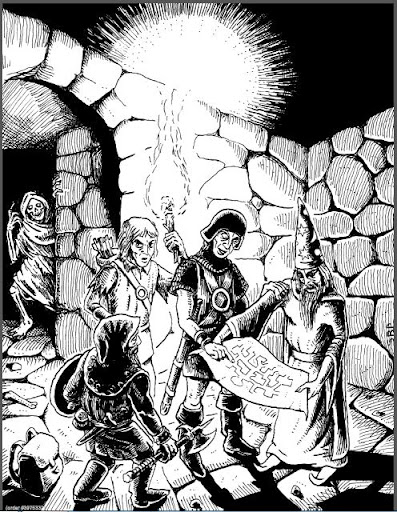 |
| “Which way do we go next?” The fighter-guy in the middle is kind of a self portrait. |
Keep on the Borderlands
Posted: September 28, 2012 Filed under: adventures, creativity, Dungeons and Dragons 6 Comments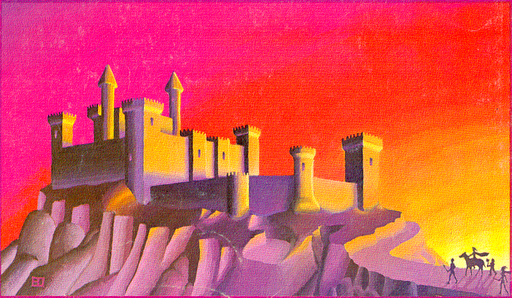 |
| If you started playing D&D in 1982 or so, you were here at some point. |
I think might be just a year or two older than the average forum lurking, blogging OD&D enthusiast because I didn’t know anything about one of the old game’s quintessential adventures, “Keep on the Borderlands” until years after it had been released. My first D&D set had a book of rules, some dice, a ‘Monster & Treasure” booklet and some maps that looked like Gary Gygax got stoned and covered a couple of sheets of graph paper in rooms and hallways that went nowhere. But for so many of my fellow enthusiasts, Keep on the Borderlands is still the true shizzle, the distillation of the D&D experience, the original article, what the game is all about, the ultimate adventure, the yardstick by which all other adventures are judged, etc. And yet I never played in it. What did I miss?
There was little rhyme or reason to those early dungeons. There would be hallways with doors sprinkled around at random and rooms filled with monsters. One room might have a group of zombies guarding a chest of silver coins, the next room might have goblins or giants spiders, etc. I don’t think any of us wondered who put the coins there or why the zombies were guarding them. We didn’t question the existence of the dungeon or why the goblins in room 2 were still alive when there was a hungry owlbear in room 3. Perhaps we were young and unsophisticated in our entertainment (the original ‘Battlestar Galatica’ was still on TV and video games were in their infancy — PONG, Centipede, PAC-MAN, etc., were considered ‘cutting edge.’). But I also think there was something else going on. We were snot-nosed punks who didn’t know shit from shinola and this game was challenging us in ways we hadn’t encountered before. We got to choose between actions and consequences. If Jim’s character was down to his last few hit points, did you announce that your character was going to jump into the fray and try to save Jim or did you slam the door and run, leaving him to his fate? We also learned of social consequences: stabbing your buddy in the back meant that his NEXT character was quite likely to stab YOUR character in turn. Maybe the consequences were not real, but the social consequences of behaving like a dick in the game taught some of the less socially gifted of our circle some good lessons in social behavior. Sometimes I wonder if this crazy game didn’t help some of us develop into actual people instead of the mouth-breathing cretins that we might have otherwise become. Or, maybe I’m just trying to justify all the time I wasted fighting orcs and ghouls while the dean of students told us we were ‘never going to amount to anything’ if we continued to play ‘that stupid game.’
So, how do we compare an adventure like ‘Keep of the Borderlands” to (for lack of a better name), “Bob’s Town and Dungeon”? (which was followed by “Stefan’s Town and Dungeon” after Bob gave up DMing duties, but I digress…) As far as a document to read, ‘Keep on the Borderlands’ is/was doubtlessly better — it features Gygaxian prose (Gygax loved his thesaurus). My home made dungeons were usually nothing more than maps with creatures and treasures tossed randomly together scrawled out in pencil; Borderlands has a fully detailed town with shops, an inn, guards, etc, with maps, illustrations, etc. The ‘Caves of Chaos’ consists of a valley filled with numerous caves (some of which interconnect) filled with different tribes (orcs, gnolls, goblins, etc.). The fans of the ‘strictly realistic’ might not find the ‘Caves of Chaos’ to their taste; it’s a bit like a “Holiday Inn” where gangs of different humanoids have checked into each suite and there are occasional rumbles down by the ice machine, but, compared to my home-made dungeons, it reads like it was written by a team of sociologists attempting to describe a dungeon eco-system with a roughly defined sort of a circle-of-life where the orcs ate goblins, goblins ate kobolds, kobolds ate rats, etc.
Playing devil’s advocate for a moment, one of the advantages of the pre-made adventure is that you can discuss it afterwards with other enthusiasts. The forums are filled with excited discussions of, “This is what happened when we played through ‘Keep on the Borderlands’ back in the day…” Maybe adventures like ‘Keep on the Borderlands’ are a part of the shared experience of the hobby. Perhaps rejecting ‘Keep’ is a form of throwing the baby out withthe bathwater. But, fuck it, part of the point of having a blog is putting whatever crazy thoughts are rolling through my head out there so anyone who cares to can read them.
Maybe I’m reaching when I compare my 13 year old self sitting down to ‘draw a dungeon’ to an artist painting a canvas… but if there is a creative component to it, I’m reluctant to disavow that by saying, “Well, Gygax is the professional, so we should stick with, ‘Keep on the Borderlands.’” Part of me feels like when people who gather to play D&D end up running nothing but pre-made adventures, they will be missing a big part of the fun (making shit up). Back in the day, one of the slogans of TSR (original publisher of Dungeons & Dragons) was, “Products of your Imagination.” If I remember right, it was printed right there on the front of “Keep on The Borderlands.” Indeed.
What is ‘good RPG writing’?
Posted: June 22, 2012 Filed under: adventures, campaigns, Dungeons and Dragons, publishing 6 Comments
As a part of my day job, I have been doing some very tedious but necessary technical writing. Basically, I’m writing manuals with step by step instructions on such fascinating things as to how to fill out a purchase requisition based on a vendor quote. In order to be useful, the ‘process documents’ I am writing need to be correct in the details and their order, clear and not subject to multiple interpretations, and as short as possible since the longer the boring document or memo, the less likely it will be read. The document that results could most kindly be described as ‘utilitarian.’
At the same time, I enjoy reading fiction that is filled with possible multiple interpretations and ambiguity (current favorite: Thomas Ligotti; my all-time favorite book is hard to choose, but might be either “Heart of Darkness” by Conrad or “The Crying of Lot 49” by Pynchon), which seems funny since I have to write stuff that (hopefully) can be understood only one way by the reader for my day job yet my favorite books are ones that seem to delight in leaving the reader more confused than when they started. Providence is always giving us the finger — the guy who likes ambiguity and multiple meanings in writing has to write as precisely as he can to earn a buck.*
Google+ gaming opinions?
Posted: April 27, 2012 Filed under: adventures 9 Comments
Has anyone who reads this silly blog done any D&D type gaming via google+ or similar platform? How did it work?
I’m particularly interested in your opinions on:
- Issues of scheduling for more long term games — did the same players always show up, was there a rotating cast of characters with a mix of ‘visitors’ and ‘regulars,’ or was every session a new gang tossed together at random? And which did you like and why?
- How did you schedule games?
- How did you share info both during and between games?
- During game did you use IM or something similar to ‘pass notes’ to one player without the other players knowing about it?
- How did social interaction via google+ or similar platforms work out?
- In terms of ‘the game experience,’ did you have a ‘board’ or diagram of some kind to help players envision the space or did you just use “talking?”
I’m considering something for the distant future when elements of real life settle down a bit, but am only at the ‘info gathering’ stage at this point.
npc class: Doctors
Posted: April 22, 2012 Filed under: adventures, aldeboran 2 Comments |
| “Now watch me destroy the sun with this stick!” |
I’m considering possible NPC classes for campaigns that will include astrologers/fortune tellers, healers/doctors and possibly scholars (although how they would function in the campaign is still something I am thinking about).
Astrologers and scholars could be sources of possible information, but adjudicating how the astrologer ‘predicts the future’ becomes difficult if, as DM, you don’t really know what the players will do next. Perhaps astrologers could provide answers to certain types of questions, i.e.: if the players ask, “What will happen if we enter Garagur’s cavern?” and the DM knows that Garagur’s Cavern is full of really dangerous monsters that are far beyond the player’s current level of ability, the astrologer, if accurate in his or her prediction, might reply that chances of returning alive are slim. Questions like, “What will happen to me tomorrow?” however, are unlikely to work simply because the astrologer won’t have anything to work with unless the player character adds a provisional statement like, “… if I do X?” Nothing of interest might occur if players just hang around their room in the inn… and even charlatans and incompetent fortunetellers could make predictions based on hunches and common knowledge and still be right at least some of the time.
On a side note, in Arneson’s original First Fantasy Campaign, Dave Arneson used random cards for rumors and the pronouncements of fortunetellers and soothsayers. Some of which described future events (like a surprise invasion of an enemy army he might have had planned), others might have been just mystical sounding gobbledygook… which inevitably leads me to think that if a player character goes to a fortuneteller and the fortune teller says some profound sounding shit like, “A dark shadow hangs over you!” and that character is subsequently eaten by a vampire, the rest of the players are going to say, “By gods, the fortuneteller was right!”
I’m suspecting that I can handle astrologers with a simple chart that cross-references the ability of the astrologer with the difficulty of the question… and the astrologer might have a chance of returning good, bad or no information (although ethically challenged astrologers might make something interesting up even if they failed to determine anything during their “research” simply because, well, who is going to pay an astrologer if he responds, “Hell if I know” to a lot of the player’s questions?) A percentage of astrologers/fortunetellers could be frauds (no useful information is ever returned, although they will gladly relieve player characters of excess gold).
 |
| “I can answer that question for 3d10 gold!” |
Scholars would probably function a lot like astrologers/fortune tellers, except they would use libraries or conduct research. Again, there would be a dice roll on a chart that would cross reference the relative skill of the researcher and the facilities available with the difficulty of the question. Scholars might be good ones to consult on questions of history, lore about obscure cults, etc. Like astrologers, some scholars could be frauds or crackpots (again, no useful information is ever returned — or perhaps on rare occasions the crackpot or fraud could be right for the wrong reasons).
 |
| Medieval doctor ready for the plague. |
The most difficult NPC for me to envision would be the doctor/healer simply because so much of that role is already performed by the cleric. Perhaps at lower levels, a doctor could be hired when players are attempting to recoup lost hit points and don’t yet have access to oodles of healing spells. Perhaps while resting under a doctor’s care, a patient would have a chance of healing at a faster rate from his injuries. ‘Cure disease’ spells might be out of the price range of many lower level players; perhaps ‘doctors’ could provide more affordable (but less foolproof) alternative nostrums. Doctors, apothecaries and alchemists might also be able to analyze and identify magic potions and similar substances — again, a chart cross referencing the difficulty of the cure against the skill of the doctor might get the job done. The biggest problem here is redundancy; who is going to go to a doctor when clerics can cast cure light wounds or resurrection? Atheists and the poor and desperate, I guess.
My real goal here is to get these different NPC types described on one page, like one of the pages from the Judge’s Guild Ready Ref Sheets, so that I wouldn’t need to describe each doctor, scholar or astrologer in detail before the game. If the players consult one of these medieval “knowledge workers’ in game, I could just make one roll for the relative skill of the service provider and another for the consultation and then tell the players the result. If a particular visit rendered bad information or failed to effect a cure, once couldn’t say for absolute certain that the service provider was at fault (although it might be fun to speculate on the competence of NPCs). This is preferable to me because I’ve often felt like the DM can succumb to the temptation of using NPCs to control the players actions too much… consulting an NPC can often be the part of the game where the DM tells the players what they have to do next. If, on the other hand, the players can gain bits of intelligence of unknown value, they can decide for themselves which leads they wish to follow.